Category Archives: 1990s

Prestige, Baby: Batman/Judge Dredd

My first “prestige format” comic book was, naturally, The Dark Knight Returns. That was the first prestige release ever, and the format only increased in popularity throughout the late eighties and nineties, driven by the overall spike in the comics market and by intense interest in specific characters. 

I have to imagine that prestige books were an easy way for publishers to clean up; maybe they cost a bit more to publish, but you still got to pay for maybe 48 pages of story (or less!) and mark it up to five or six bucks a pop. 

This “golden age” of prestige one-shots was a fertile time for our favorite Caped Crusader as well, arriving during Batman’s first great run of megapopular movies. Again, the opportunity was too great for DC to pass up. In this occasional series, we’ll take a look at some of the many, MANY prestige format one-shots published during this era. 

O, dystopia! 

It provides the location for so much speculative fiction, as well as an easy out for writers who are too lazy to do anything more creative with their ideas. Even the most trite, unoriginal plots gain a little gristle when dropped into a hopeless future. 

Which is not to say that Judge Dredd is a trite or unoriginal character. In fact, it’s probably fair to say that his emergence in the pages of 2000AD in 1977 helped establish the popularity of bleak dystopia in comics. From that fertile ground grew some of Alan Moore’s biggest hits of the 1980s and even the seminal Frank Miller joint The Dark Knight Returns. Perhaps it’s a jagged, dotted line between the two, but you can definitely see the connection. 

All of that precedent makes the (inevitable?) meeting of Batman and Judge Dredd in Batman/Judge Dredd: Judgment on Gotham a bit of an anticlimax. With the success of the character’s dark and satirical stories, Judge Dredd helped begat the late 80s bleakness across the Batman line; the Bat-mania from 1989’s Tim Burton film demanded a glut of Bat-product to fill the Bat-shelves; by 1991 it was still going strong, inviting this one-shot by Alan Grant, John Wagner, and Simon Bisley. When Batman ends up in Mega-City One through some technobabble Macguffin, it’s like he’s visiting home. 

So much of reading and writing about old comics is just examining these strange things as artifacts of their time and their cultural moment. This book would not exist if Batman comics weren’t in such huge demand in 1991, buoyed by the general rise in sales thanks to the dawn of the speculator boom. There’s also the sense in which the book’s tone is itself attempting to react against the push toward more graphic and “adult” storytelling in funnybooks. This was before the mature readers label existed, and so it’s jarring to flip through the book and see some of Judge Death’s incredibly gruesome murders, or the full page set in Judge Anderson’s apartment where she answers the phone in the middle of the night and climbs out of bed, wearing naught but a G-string and apparently oiled as though she were prepared to race off to an emergency weightlifter competition at any moment. 

This is a very 90s comic in its way, but featuring a character who inspired much of the tone of 90s comics, written by guys who themselves invented a lot of the tricks in 90s comics back when they were really daring in the late seventies and early eighties. If their attempts at gross out humor or “butt” puns fall a bit flat, it’s hard to blame them; that material killed before everybody and their brother swiped it. 

Storywise, it’s hard to fault Grant and Wagner, since their plot echoes the comfortable beats of just about every cross-universe superhero team-up. There’s a misunderstanding, a battle between the heroes, an unlikely alliance between signature villains, and then a climax in which both heroes save the day and say goodbye, but not before they realize that HEY, maybe they weren’t so different after all. They’re both workhorse legends in British comics, and Grant has the added benefit of approaching the book in the midst of his own time on both Detective Comics and Batman, along with artist Norm Breyfogle. They both “get” Dredd and Batman. 

The star of this book, and the reason to give it at least a flip-through twenty-five years later, is Simon Bisley’s artwork. Bisley also came up through the ranks at 2000AD before making his way to the states and finding success as one of the signature artists on Lobo, a character who also owes much of who he is to the Dredd aesthetic and tone. 

Bisley takes full advantage of this stand-alone prestige release to create a stand-alone visual universe that plays to his strengths, bright grotesque figures rising up out of a dark miasma. His character designs are outsized and impressionistic, with flashes of extravagant detail that push the look toward an almost abstract feeling at times. It’s virtuoso work, and even when the book’s plotting falls into comfortable storytelling grooves, the visuals carve into unexpected territory. 

Bats and Legends: “Gothic”

In college, I did a senior year thesis on Frank Miller, Klaus Janson & Lynn Varney’s The Dark Knight Returns, heavily inspired by Scott McCloud’s exceptional Understanding Comics. He explores a topic in that book that he calls “closure,” which is the reader’s effort to fill in the narrative or movement “blanks” between panels. It’s the imaginative leap that makes comics work. I wrote about a concept called “emphasis,” which is the creator’s choice of what to depict in any given panel–part illustration, part animation, part cinematography. 

While the choice of emphasis by an artist seems obvious when a panel simply conveys story information, it’s just as often used to set mood and meaning. That was the crux of my thesis–a close read of the sequence in Dark Knight where Bruce Wayne recalls the death of his parents. We see closeups of Martha Wayne’s pearl necklace caught by the arm of her attacker; as the attacker pulls his arm away, the necklace is pulled apart. We see the necklace stretch and the pearls separate in excruciating detail. More than just suspense, this sequence builds an excruciating tension because of Miller’s emphasis in key panels on the pearls versus any number of other images he could have used to convey the same information.

Action sequences are another place where emphasis plays a huge role–the choice of what positions to depict for the participants can help convey a sense of motion, or if they appear too posed, give the sequence a halting, motionless feeling.

Klaus Janson’s work on “Gothic” has me thinking about emphasis again, because as a penciler, he chooses some weird poses to capture in his art.

Batman_Legends_of_the_Dark_Knight_006_1990
This is Batman rousting a thug, pencils and inks by Janson.

In a sense, it’s similar to any number of familiar images of Batman–the dark knight falling from above with menace in his eyes, his arms outstretched, cape furling in the wind.

Except that’s not quite what we get here. There’s nothing that establishes Batman as being above the ground prior to this page, so it’s not clear of he’s dropping down from a height or maybe standing from a crouch. His arms aren’t outstretched, holding his inky black cape aloft; they’re in mid-motion, either extending the cape or bringing it in.

It’s a lived-in, real version of an image that’s existed before, and will exist countless times again. Janson’s own inks give the moment (and many others throughout the book) a kinetic charge, as close to a jump cut as you’ll see in comics.

But there is a firmness, a solidity in the image, and it’s in Batman’s face. That half-smile. It leaps out from the page. His full frame isn’t quite as menacing as his expression. And he dominates the rest of the page–not just because his reveal fills the top two-thirds but because he and his cape are in the foreground of almost every other panel.

It’s that preference for emphasizing unconventional moments and his disciplined control (or intentional lack thereof) of his line work that make Janson one of the all-time greats.

“Gothic” marked masturbatory shaman Grant Morrison’s first foray into Gotham City. In it, he shows a remarkable amount of restraint; his Batman is violent when necessary, thoughtful and careful otherwise. He can roust thugs on the streets one night and arrive in Vienna a few days later to visit a monastery in broad daylight. 

Unlike some of Morrison’s other Batman projects, in “Gothic” he’s building a veneer of normalcy around a supernatural villain, Mr. Whisper. He uses the trappings of a grounded Gotham and a shoe-leather crimefighter to contrast against the eerie strangeness of his antagonist, a former monk from 300 years ago who embraced sin and made a deal with the devil to live for centuries in exchange for his soul. 

Mr. Whisper has a whacked-out plan to use an architectural trick in Gotham Cathedral to unleash a new plague on the city. But he emerges in the story for very pedestrian reasons, at least in the Bat-verse–he’s tangled with Gotham mobsters in times past, and he returns to the city to gain some revenge. 

Morrison overreaches a bit by casting Mr. Whisper not only as an immortal sadist and a serial killer, but also somehow one of Bruce Wayne’s teachers at boarding school. But he does pick up a set of plotting threads that play off the Year One theme of Legends’ early storylines, one that we’ll see later writers pick up as well–mirroring Frank Miller’s original tale, Morrison parallels storylines set in Gotham’s criminal underworld, in the city’s police ranks, and in the adventures of Batman himself. At times, it’s clever to watch creators play with those threads and weave them together; in other storylines, as we’ll see, it’s a burden more than an aid. Morrison makes the most of it, and it gives him license to ease into Mr. Whisper’s supernatural origins after introducing him as a seemingly run-of-the-mill mob killer. 

Next: Moench/Gulacy/Austin on Prey

**A brief postscript–a far better critic than I has already tackled this story, and that’s comics blogger and all-around exceptional writer Tegan O’Neil. In fact, she toyed with doing her own story-by-story write-up of Legends of the Dark Knight in 2015. I’ll be linking to the pieces she completed as I finish my own write-ups, so by all means, visit her take to get a more Morrison-centric look at “Gothic.” And here’s her piece on the previous storyline, “Shaman.”

Bats and Legends: “Shaman”

Four covers…advantageous!

As any Bat-fan worth their salt already knows, 1989 was a seismic year in the history of Batman, due primarily to the release of Tim Burton’s film in June. 

With that movie’s explosive popularity came any number of attempts to cash in, from T-shirts and toys to trading cards and (I would assume) toilet paper. As the publisher of Batman comic books for fifty years, DC Comics was uniquely positioned to reap the benefits of a hit Batman movie. 

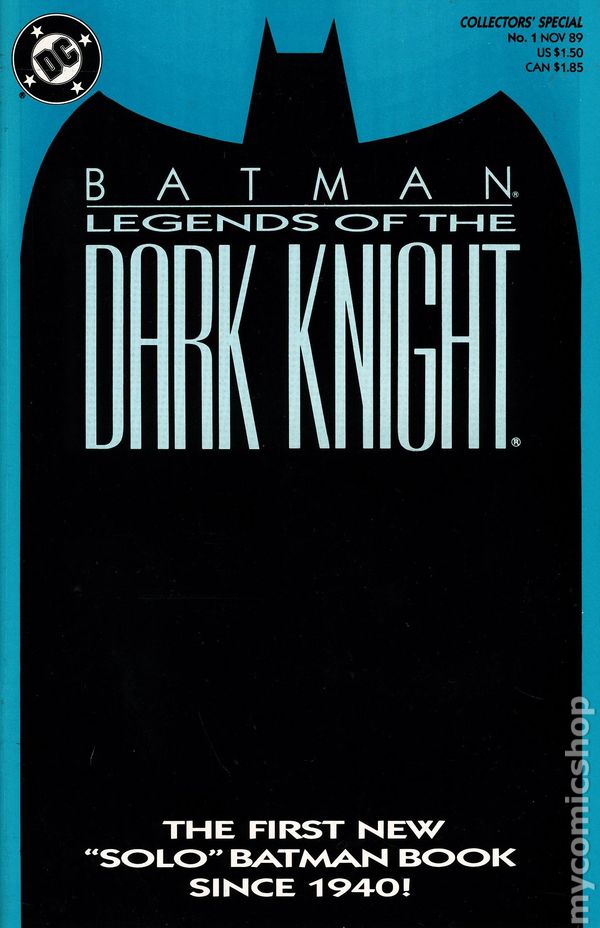
And so it came to pass that in November, they launched Legends of the Dark Knight, which they billed as “the first new solo Batman title since 1940!” This was a ham-handed attempt at infusing the launch with more gravitas than it deserved; it may have been technically true, but everyone knew that there had been countless Batman series launched and relaunched in the decades since Batman #1 hit the stands. 

Still, it was the late eighties, the start of a heady period in comics publishing, when anything that could be An Event became An Event. So Legends #1 was a Big Deal with four separate covers…actually, four separate cover wraps, which is absolutely cheating. The cover itself was the same, but a separate piece in four garish neon pastels was attached to the book, forcing completists and speculators alike to track down all four colors for their collections and/or future college funds. 

This series lasted until 2007. It spanned four additional Batman movies, four animated series, and some OnStar commercials. It told the kind of stories that the “real” Batman books could never tell–stand-alone tales, often just loosely in continuity, and many times focusing on the early years in Batman’s career. 

I read and collected many of the issues of Legends as it was published. I’m going to try to read and write about every storyline in the series, as an exploration of the character and his world, and an examination of how a wide range of different writers and artists approached the character. I will probably give up at some point out of sheer exhaustion–there are probably upwards of 100 different stories told over the 215 issues of the original series, plus 10 annuals and specials–but we’ll see how it goes. 

“Shaman” is the storyline that kicks off Legends, stretching across issues 1-5. The issues are written by Dennis O’Neil, aka Denny, who also edited the entire line of Batman comics for DC from 1986 to 2000; art duties are covered by penciler Ed Hannigan and inker George Pratt. 

O’Neil is a towering figure in the history of Batman; as an editor, by 1989 he’d already had a hand in the two foundational stories of modern Batman, both by Frank Miller–Year One and The Dark Knight Returns. Those two stories were themselves influenced by O’Neil’s foundational work as a writer with artist Neal Adams on Batman in the 1970’s, widely credited with returning the Bat to a more grounded, gritty tone after the camp explosion of the sixties. 

Year One and Dark Knight Returns effectively bookend Batman’s fictional career–Batman’s origin in the death of Bruce Wayne’s parents has been clear enough since the 1940s, but Miller used these two stories to expose the psychological underpinnings of that seminal event. It didn’t change Bruce Wayne as much as it transformed him, destroyed him; if there was ever a question before, it was clear from 1986 on that Bruce Wayne was the mask, and Batman was the reality. 

In “Shaman,” O’Neil picks up on that dichotomy and explores it as it began, weaving in key moments from Year One and squarely placing this particular murder investigation between the panels of that previous work. O’Neil’s intellectual curiosity bleeds through in much of his work, and here it’s an effort to connect bits of Native American mythology to the Batman mythos. Honestly, it’s a little unclear whether the central parable O’Neil relates is an invention or drawn from his research, but either way, it’s an overt tie to the more mystical aspects of Native American history. 

There’s definitely something of the Magical Native American trope at play in this story; at the same time, Hannigan’s pencils give these characters a lived-in reality, and he uses a clever stylistic shift to illustrate the actual bat-related parable that lies at the center of the tale. Hannigan also instinctively understands that one of the keys to a great comics fight scene is effectively depicting motion.

“Shaman” is not a great Batman story; it suffers from a frequent weakness of stories with long-running characters, where the author feels the need to relate what’s happening to some other landmark event in the character’s history. Here O’Neil stretches a bit too far to suggest that the famous bat crashing through Bruce Wayne’s window was somehow related to the mystical healing efforts of a Native American in Alaska. 

But in “Shaman,” Batman is pretty great. O’Neil nails the tense, passive-aggressive banter between Batman and Alfred, and isn’t shy about throwing in some well-choreographed fight scenes. Hannigan’s Batman is all business, lean and powerful, and there are a few classic Batman breathtakers in here that showcase the Dark Knight in all his nocturnal glory. 

I think what I like most about O’Neil’s writing is that he’s so well versed in the simple rhythm and style of crime fiction. He writes a great Batman but he also crafts great thugs and cops. His work on the character, especially in the post-Year One era, feels like Batman wandering into a James Cain novel. It instantly grounds the action and provides a helpful context for the activities of a nutty genius running around in a bat costume. 

Next: Grant Morrison’s first take on Batman