Category Archives: Denny O’Neil

Bats and Legends: “Destroyer”

“Comics will break your heart,” or so the saying goes, and while I’ve never had my work exploited for a billion-dollar movie franchise or had to beg a publisher to pay my invoice so I could cover rent, I have had a few little heartbreaks, here and there, over the years. 

This issue of Legends of the Dark Knight was surely one of the first–a title seemingly created to tell stand-alone stories over several issues from the early days of Batman’s career, suddenly shoved into a three-part crossover with Batman and Detective Comics. Sure, I was buying all three titles, that’s not the point. The point is that when faced with any decision pitting creative value over additional revenue, comics publishers will always choose the latter. 

This will only become more horrifying as we get into the era of Knightfall and KnightsQuest and KnightSweats, all those gigantic storylines that pull in every single Batman series to tell a big stupid saga. Heaven forbid one Batman title get left alone to serve as antidote to an era of endless cash-grab crossovers. 

Like I said, I was a teenage Batfreak who bought all these issues slavishly when they came out, so I had all three parts teed up in Ye Olde Longboxes. It’s an interesting story because Alan Grant, who was all over the Batman books in that era, writes parts one and three, leaving dependable Denny O’Neil to pen this middle chapter. On pencils, we get Breyfogle and Aparo on the other titles, and none other than…Chris Sprouse on this issue. 

That’s right–it’s a Dennis O’Neil script drawn by Chris Sprouse, and it’s plopped in the middle of a three-part crossover story designed to give some love and possibly publishing fees to Anton Furst, the production designer whose vision of Gotham City animated the two Burton Batman films. 

Based on the checklist at his website, this was in the earliest days of Sprouse’s penciling career. (I forgot he drew a Batman annual written by Andrew Helfer, which I will have to check out.) What’s great about it is that it is immediately recognizable as Sprouse; he apparently didn’t have to suffer through a period in his early career where he was asked to adapt to a DC “house style.” And from the jump, Sprouse’s Batman is terrific. He leaves the eyes white, creating an extra emphasis on Batman’s facial expressions. Look at this somewhat surprised Batman. 

He doesn’t overdo it; it’s not exaggerated. But leaving those eyes without detail forces us as readers to rely upon the rest of Batman’s expression to interpret his mood–alert, engaged, slightly taken aback. 

There’s not a lot of big visual moments in the issue, other than a terrific page where Sprouse depicts the Wayne Foundation building collapsing thanks to a criminal’s bombs. 

Three vertical panels, perfectly visualizing the entire point of the conflict in the story–a crazed architecture freak who destroys newer buildings in Gotham so that the city’s oldest gothic facades are more visible. 

Perhaps in a nod to the title’s intent, O’Neil does include a backward-facing moment where a flashback illustrates the Wayne family’s connection to the architectural style Gotham has developed as its trademark–which happens to be the same style Furst imagined for Gotham in his designs for the first two Batman movies. Beyond that, this is not a complicated story, although it is clever. The motivation of a villain who sidesteps his way into manslaughter by way of his passion for architecture is something different, and it connects well to the inclusion of Furst’s designs, which was definitely meant to capitalize on the ongoing Bat-fever as a world waited with breath bated for the premiere of Batman Returns in June 1992. 

I enjoyed these three issues, both at the time and upon a re-read nearly thirty years later. And yet, I can’t help but recall how this moment also marked the beginning of the end for my illusions about comics. Sure, I’d happily lapped up the 1991 annuals to follow Armageddon 2001, but mess with Batman, and you’re crossing a line. 

Next: Matt Wagner and “Faces”
Bats and Legends: “Venom”

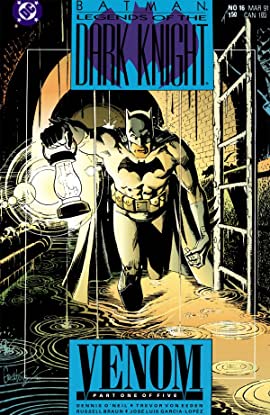
Just ten issues after his first storyline for Legends of the Dark Knight (“Shaman”), Denny O’Neil is back behind the word processor again for “Venom,” a five-parter with artists Trevor Von Eeden (layouts), Russell Braun (pencils) and the great Jose Luis Garcia Lopez (inks). 

That’s a murderers’ row of talent, and it’s a shame that the work doesn’t live up to their reputations. “Venom” is known today more for what it introduced into the DC Universe than for the story itself–the “venom” in question is the same narcotic cocktail that will create Bane, and this story brings the drug to Santa Prisca, a fictional South American country invented by O’Neil during his run on the Question. We will eventually learn that Bane hails from Santa Prisca, where he was forced as a child to serve time in a maximum-security prison because his dad escaped–the kind of insane version of “justice” only a mid-nineties comic book writer could come up with. 

“Venom” feels like a logline in search of a story, a character, a theme; anything to justify its existence beyond the simple high concept of “Batman gets hooked on performance-enhancing drugs.” It feels incredibly dated, its understanding of the illegal drug trade and its impact on the U.S. informed largely by the waning days of the first War on Drugs. Characters behave in ways that defy our previous understanding; Alfred functions solely as a long-suffering quip machine, his droll one-liners awkwardly punctuating even the most dramatic moments. 

There’s something lumbering and gawky about the way it’s plotted, too; you have this big fat hook, “this is your Batman…on drugs,” and then he overcomes the addiction by the end of the third issue in the story, just so that he has time to play the Schwarzenegger role in a warmed-over redo of Commando. You can see O’Neil is trying to build sympathy around the son of one of the story’s two villains, but his father is such a grotesque pantomime of “old Army dude practices tough love on his family” that it defies belief. 

Also beyond caricature is the “evil scientist” who creates “venom.” Batman’s inciting event in the story is the death of the scientist’s daughter in a drowning that Batman could have prevented if only he’d been physically stronger. When Batman appears to tell the scientist about the death of his daughter, the scientist barely reacts; within a few panels, Batman is taking the guy’s pills. It’s probably a bad idea to trust the pharmaceutical recommendations of a sociopath who can’t bother being upset about his young daughter’s death by drowning. 

Tegan O’Neil does a much better job of dismantling this arc than I could. “Venom” has been around long enough that it feels like a necessary evil, a bedrock of the modern Batman mythos that exists solely because it has to. It gave us the Venom drug, which begat Bane, which begat Knightfall and countless other Bane stories and eventually The Dark Knight Rises. In spite of its dated, cloying story and unrealistic characterizations, we’re probably stuck with it. 

Bats and Legends: “Shaman”

Four covers…advantageous!

As any Bat-fan worth their salt already knows, 1989 was a seismic year in the history of Batman, due primarily to the release of Tim Burton’s film in June. 

With that movie’s explosive popularity came any number of attempts to cash in, from T-shirts and toys to trading cards and (I would assume) toilet paper. As the publisher of Batman comic books for fifty years, DC Comics was uniquely positioned to reap the benefits of a hit Batman movie. 

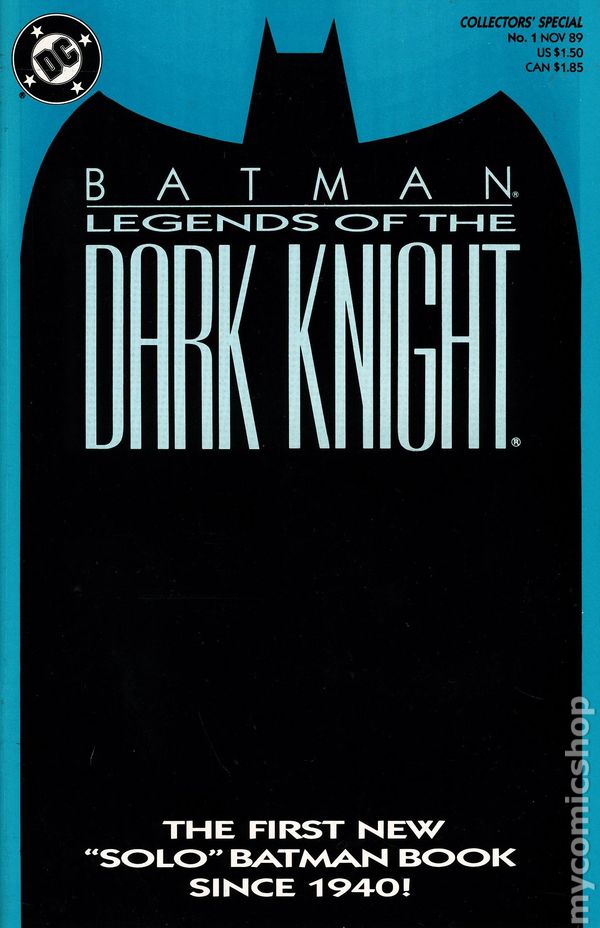
And so it came to pass that in November, they launched Legends of the Dark Knight, which they billed as “the first new solo Batman title since 1940!” This was a ham-handed attempt at infusing the launch with more gravitas than it deserved; it may have been technically true, but everyone knew that there had been countless Batman series launched and relaunched in the decades since Batman #1 hit the stands. 

Still, it was the late eighties, the start of a heady period in comics publishing, when anything that could be An Event became An Event. So Legends #1 was a Big Deal with four separate covers…actually, four separate cover wraps, which is absolutely cheating. The cover itself was the same, but a separate piece in four garish neon pastels was attached to the book, forcing completists and speculators alike to track down all four colors for their collections and/or future college funds. 

This series lasted until 2007. It spanned four additional Batman movies, four animated series, and some OnStar commercials. It told the kind of stories that the “real” Batman books could never tell–stand-alone tales, often just loosely in continuity, and many times focusing on the early years in Batman’s career. 

I read and collected many of the issues of Legends as it was published. I’m going to try to read and write about every storyline in the series, as an exploration of the character and his world, and an examination of how a wide range of different writers and artists approached the character. I will probably give up at some point out of sheer exhaustion–there are probably upwards of 100 different stories told over the 215 issues of the original series, plus 10 annuals and specials–but we’ll see how it goes. 

“Shaman” is the storyline that kicks off Legends, stretching across issues 1-5. The issues are written by Dennis O’Neil, aka Denny, who also edited the entire line of Batman comics for DC from 1986 to 2000; art duties are covered by penciler Ed Hannigan and inker George Pratt. 

O’Neil is a towering figure in the history of Batman; as an editor, by 1989 he’d already had a hand in the two foundational stories of modern Batman, both by Frank Miller–Year One and The Dark Knight Returns. Those two stories were themselves influenced by O’Neil’s foundational work as a writer with artist Neal Adams on Batman in the 1970’s, widely credited with returning the Bat to a more grounded, gritty tone after the camp explosion of the sixties. 

Year One and Dark Knight Returns effectively bookend Batman’s fictional career–Batman’s origin in the death of Bruce Wayne’s parents has been clear enough since the 1940s, but Miller used these two stories to expose the psychological underpinnings of that seminal event. It didn’t change Bruce Wayne as much as it transformed him, destroyed him; if there was ever a question before, it was clear from 1986 on that Bruce Wayne was the mask, and Batman was the reality. 

In “Shaman,” O’Neil picks up on that dichotomy and explores it as it began, weaving in key moments from Year One and squarely placing this particular murder investigation between the panels of that previous work. O’Neil’s intellectual curiosity bleeds through in much of his work, and here it’s an effort to connect bits of Native American mythology to the Batman mythos. Honestly, it’s a little unclear whether the central parable O’Neil relates is an invention or drawn from his research, but either way, it’s an overt tie to the more mystical aspects of Native American history. 

There’s definitely something of the Magical Native American trope at play in this story; at the same time, Hannigan’s pencils give these characters a lived-in reality, and he uses a clever stylistic shift to illustrate the actual bat-related parable that lies at the center of the tale. Hannigan also instinctively understands that one of the keys to a great comics fight scene is effectively depicting motion.

“Shaman” is not a great Batman story; it suffers from a frequent weakness of stories with long-running characters, where the author feels the need to relate what’s happening to some other landmark event in the character’s history. Here O’Neil stretches a bit too far to suggest that the famous bat crashing through Bruce Wayne’s window was somehow related to the mystical healing efforts of a Native American in Alaska. 

But in “Shaman,” Batman is pretty great. O’Neil nails the tense, passive-aggressive banter between Batman and Alfred, and isn’t shy about throwing in some well-choreographed fight scenes. Hannigan’s Batman is all business, lean and powerful, and there are a few classic Batman breathtakers in here that showcase the Dark Knight in all his nocturnal glory. 

I think what I like most about O’Neil’s writing is that he’s so well versed in the simple rhythm and style of crime fiction. He writes a great Batman but he also crafts great thugs and cops. His work on the character, especially in the post-Year One era, feels like Batman wandering into a James Cain novel. It instantly grounds the action and provides a helpful context for the activities of a nutty genius running around in a bat costume. 

Next: Grant Morrison’s first take on Batman