Category Archives: Comics

Bats and Legends: “Faith”

Imagine you wake up one morning and read in the newspaper that–

(Hahahahhaa, just kidding, newspapers are DEAD)

One morning, you read on the Tweeters that a guy dressed up as a bat spent the night before beating up criminals and depositing them at the police station in your city. Next night, same thing. Then another night. It goes on. 

How would the average American citizen in 2021 respond to such an occurrence? Fear? Excitement? Support? Disgust? 

Probably indifference. Maybe I’m wrong; we have seen an unprecedented rise in righteous protest as the Black Lives Matter movement swept the nation. Maybe people would take to the streets with bat-logo poster boards and march on City Hall to show their support. On the flip side, there would likely be a handful of nutjobs who would take this as an opportunity to load up their vans with hollow-tipped bullets and plastic explosives to conduct their own personal war on crime. 

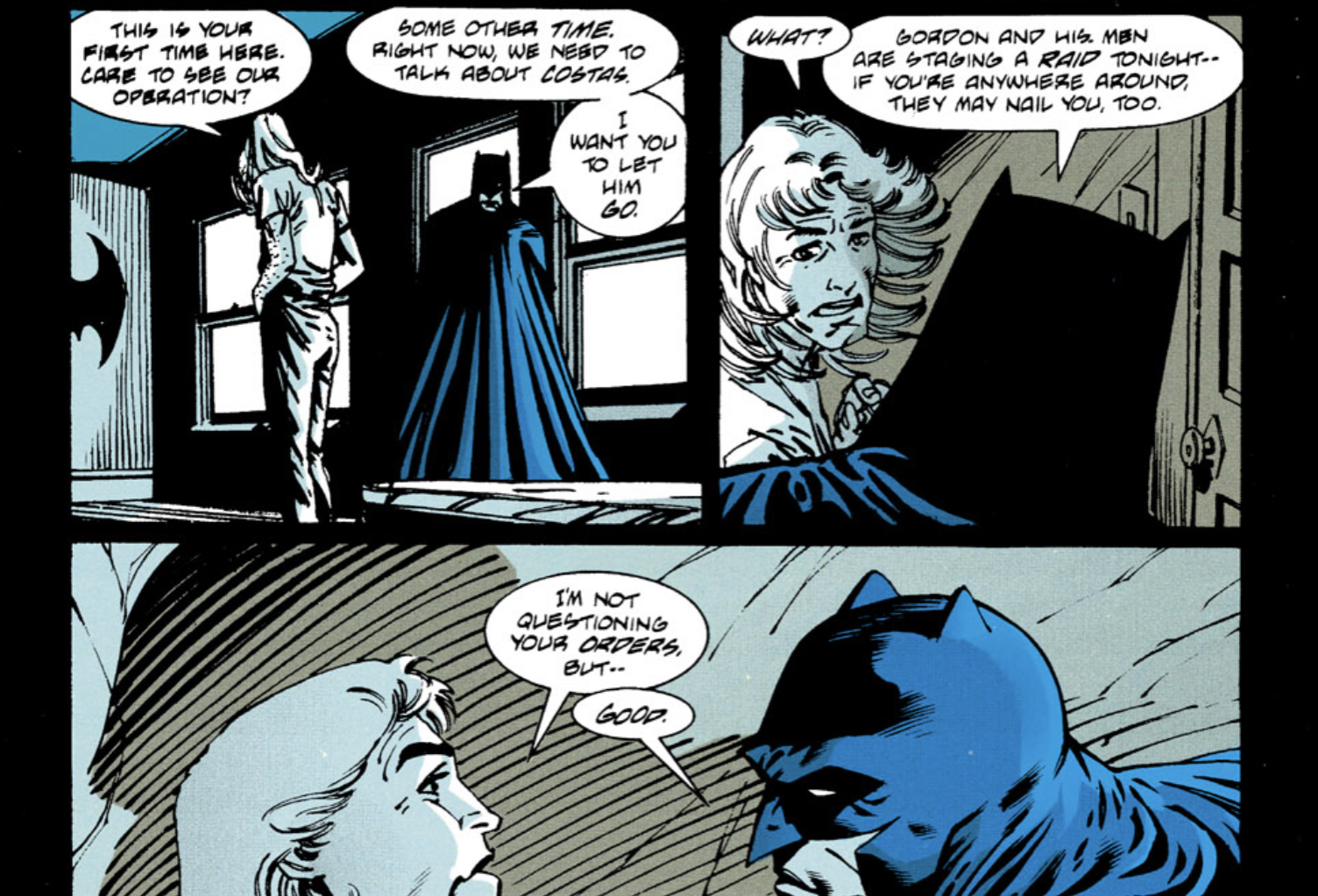
This all comes to mind as we consider “Faith,” a three-part story from Legends of the Dark Knight issues #21-23, with words by Mike Barr and pencils by Bart Sears. The “vigilante inspires other vigilantes” storyline is a leitmotif across Batman’s publishing history; in this scenario, it takes root within a former drug addict named John Ackers who overdoses, recovers, and then recruits some of his neighbors to build a Batman-inspired “gang” for positive change in the neighborhood. Unfortunately, John is also having some crazy visions (withdrawl-inspired?) about a giant fantastical Batman telling him to kill the guy who sold him the drugs that made him overdose. Batman has to juggle good intentions driven by insane hallucinations, and the bad behavior of the actual drug syndicate, along with the continuing efforts of the Gotham police to put him behind bars. Dr. Leslie Thompkins appears in a subplot where she learns that Bruce Wayne is Batman, forcing her to come to terms with her disdain for the vigilante and her maternal feelings for Bruce. 

I became aware of Bart Sears through his time penciling Justice League Europe; these three issues appear to have been published concurrently with his later issues on that series. This is likely to my own detriment but I always saw Sears as a “beefcake” artist, known for drawing outlandishly built men and women in tight-fitting spandex costumes. There’s certainly some of that here with regard to Batman, but I’m also struck by how effectively his elaborate, amplified style adapts to depicting mere mortals. I especially enjoy his version of the drug-addict-turned-community-activist John Ackers; he depicts him on a thin line between reality and exaggeration that allows for an easy transition between the character we see in the “real world” and the one contorted into unreality by his hallucinations. 
The publishing history of Batman hasn’t been dominated by the kind of Batman stories that seem most prevalent and popular today–big tales where teeth-gritting, endless loss, and villains constantly trying to destroy Gotham City are the order of the day. 

No, the vast majority of Batman stories are still relatively small, chronicling not the earth-shattering stories where “nothing will ever be the same” (until it is, eventually), but the ongoing adventures you’d expect from a guy in a bat suit who fights crime. Every night can’t destroy the status quo, otherwise there’d be no quo to status. Most nights are spent on the streets of Gotham, beating back an ever-breaking tide of superstitious, cowardly criminals who are relentless in their pursuit of the same sins and vices you’d see in any American city. Robbery. Bribery. Drugs. 

This is one of those smaller stories, character-driven, showcasing how the impact of the Bat can loom just as large on those he saves as it can on those he condemns. It’s a relief in some ways; a nice tight three-parter is a breath of fresh air after four consecutive five-issue stories (each of which could have probably been tightened into a four or three-issue affair, but I digress). 

Next: Chaykin, Kane, and “Flyer”

Alan Moore’s (Other) Batman Stories

Alan Moore has written a few Batman stories…none of which are really about Batman. He’s written stories in which Batman appears. 

His most famous (and notorious) Batman story, The Killing Joke, is really a Joker story. Batman’s a supporting character at best. Moore also deployed Batman to great effect in stories from both Swamp Thing and his famous Superman annual, “For the Man Who Has Everything.”

But Moore has two other Batman stories, one of which has never even been printed here in the United States, and isn’t comics at all. “The Gun” appeared in a 1985 UK Batman annual. It’s a prose short story by Moore with spot illustrations by Gary Leach, who draws a pretty sinister Batman. The titular weapon is (SPOILER) the gun that shot young Bruce Wayne’s parents, and it’s being utilized by Johnny Speculux, a graffiti-tagging thug with the most 80s British nickname in the history of the planet.

It’s one of those things where the weapon carries all this anger and rage which it then somehow mystically ejaculates through a variety of emissaries, including Joe Chill, before meeting its own demise eventually along with Mr. Speculux. Batman’s hardly in it, and when he is, it’s not a very distinct or inspired Batman. He has a nice short moment with a little girl who saw her own parents murdered by Speculux at an only-in-Gotham art exhibit of gigantic home furnishings (nice Dick Sprang homage there). 

Like Moore’s Star Wars stories for the UK Empire Strikes Back magazine, “The Gun” is clever and short. It’s a blunt instrument of a story, like something you’d read in 2000AD or even the EC books. It’s even got a “creepy” twist ending that brings the central theme of revenge back to its logical starting point, with Bruce Wayne as just another casualty caught in the crossfire. I very much liked this bit about Batman:

“He was staring at Johnny Speculux, and there was something familiar in his eyes…They had all of the seething, emotional intensity of a child’s eyes, but they were set into an adult’s face and the effect was terrifying.”

There’s something about little Bruce Wayne’s eyes living on in the visage of Batman; it’s a unique evocation of a theme that has since become trite, which is that Batman is little more than the seething wound left open by the death of Thomas and Martha. Back then, it wasn’t quite as overdone, and drawing our attention to Batman’s eyes puts us squarely in Johnny Speculux’s shoes, because while we don’t know that much about Johnny, we know everything about Batman’s vengeance, and we know it is a terrifying thing, even through the eyes of a child. 

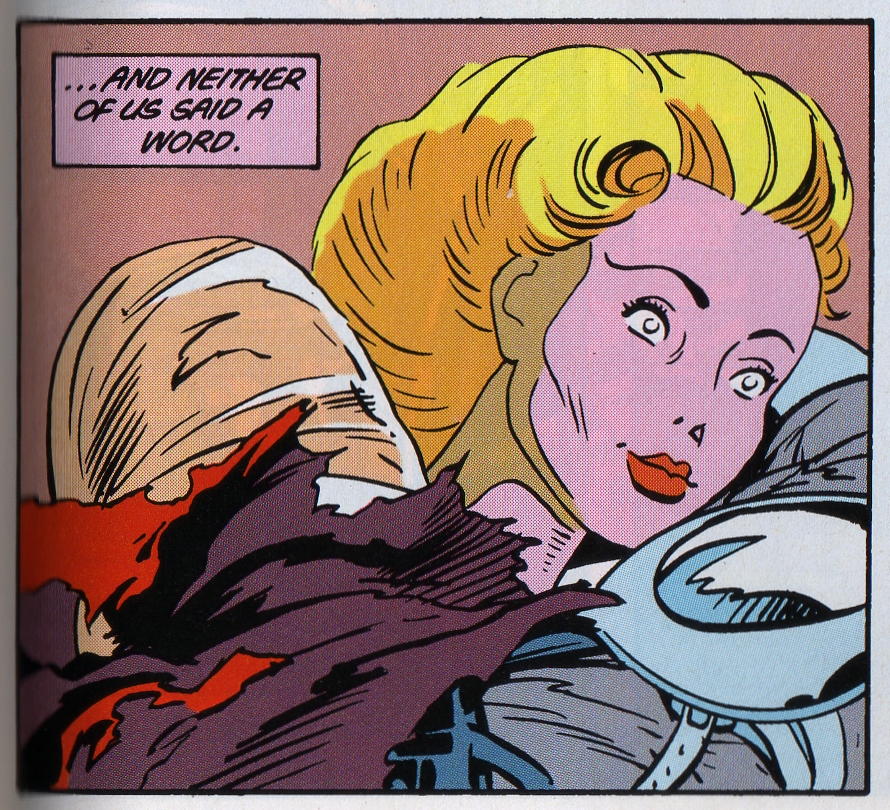
Moore’s other significant Batman story is from Batman Annual 11, “Mortal Clay,” with art by George Freeman. This one is a Clayface tale focused on the third villain to claim the title, Preston Payne. It’s a full-length comics story, not a four-page prose story, so Moore stretches out a bit and offers a glimpse inside the mind of a man obsessed with a mannequin. His “lover” is “Helene,” and the entire story is told from his point of view, so it becomes a series of cuckoldings in which a security guard and Batman both become “the other man” in his twisted brain.

Payne’s interior monologue is what provides the thruline for “Mortal Clay,” and there’s moments where Moore definitely lets the character ramble on, but it’s still a compelling narrative technique, especially since the comics format is so uniquely suited to utilizing voiceover and image to comment on each other. 

All you really need to know to get that he’s crazy is that Preston Payne is in love with a mannequin. Seeing it laid out as above, with “…and neither of us said a word” as counterpoint to the dead chilling face of “Helena,” is Moore mining the potential of comics for its full potential. 

So much of what I love about Moore comes down to his exceptional ability to pull off moments just like that one. He is a supreme master of comics as a unique storytelling vehicle–part prose, part image, part something else entirely. Whether it’s a minor moment of Clayface hugging a mannequin or the virtuoso construction of Watchmen’s fifth issue, where Moore and Gibbons together build a “Fearful Symmetry” into the DNA of the page layouts themselves, Moore is so completely comfortable with the multiple levels on which sequential art can operate that his stories always redeem multiple readings. Even when he’s just telling a Batman story that’s not much about Batman for a random annual, meant to do little more than pile onto the limitless and ever-growing mountain of ongoing superhero fiction. 

Batman himself doesn’t appear significantly until the final sequence of “Mortal Clay,” when he shows up to capture Clayface and is mistaken for the latest lover to steal the heart of “Helena.” Clayface and Batman fight, until Clayface collapses in a distressed heap before his mannequin, and Batman…offers his hand to the villain. 

We then learn that while Clayface has been restored to Arkham Asylum, thanks to Batman’s intervention, he’s been allowed to live in relative happiness with “Helena.” It’s a side of the Caped Crusader we don’t see very often these days, but it’s welcome when it does appear; Batman has pity and mercy for many of his sickest adversaries.

These handful of stories don’t give us a great idea of Moore’s vision for Batman, except that Batman functions solely as a supporting or inciting character in each tale. That’s a decision by itself, and it suggests Batman as a figure of menace and mystery. Even as Moore wrote his Batman stories decades ago, the Caped Crusader’s interior life was becoming somewhat over examined. Placing Batman as a secondary character in his own story allows Moore to focus on Batman’s milieu and examine the character as reflected through others. 

Of course, we could spend days dissecting the elements of Batman that inspired aspects of Rorschach from Watchmen… 

That’s the thing with Batman: Even if you’re Alan Moore, Batman’s never really far away.

Batman: The Detective #1-3 (Review)

It was probably an accident of publishing circumstance that resulted in Batman making his debut in a title called Detective Comics, but since that first appearance in 1939, Batman has been synonymous with detective work–investigation, interrogation, tracking clues and suspects, and then fitting all those pieces together into a complete picture. 

Those are some of my favorite Batman stories, because they underscore Batman’s humanity and brilliance. He can’t use X-ray vision to see through walls and spot things; he can’t race across town in an instant to catch a criminal in the act. He can observe and deduce, just like any of us could, and he’s very good at it. 

Tom Taylor and Andy Kubert have served up a decent Bat-mystery so far in their Batman: The Detective miniseries (issue 4 hits stands today, July 13). The six-issue mini takes place in what appears to be a future state moving toward Frank Miller’s Dark Knight Returns. That’s a bit of conjecture on my part, but the way Kubert draws Bruce Wayne seems to indicate this is a character moving toward the hunched, sinewy Batman that Miller envisioned for his take on the character’s last adventures. 

And Kubert…well, Kubert draws the hell out of it. I’m not sure what got us here, to Andy Kubert drawing a six-issue mini set in a possible future that has no great stakes for the wider DC Universe. But I am glad we’re here. Every issue has at least one drop-dead moment of kinetic glory–in issue 1, it’s this full-page rendering of Batman confronting a fully demonic Gentleman Ghost. 

Kubert is first and foremost a visual storyteller, so this isn’t just a showy moment; paired with tight scripting from Taylor, this is an essential beat in the issue. I love the lead-in dialogue from Batman on the preceding page: “Squire, I want you to walk toward me, and whatever you do…” It cleverly sets up the reveal and the stakes at the same time; Batman’s going to be fighting for his own life, but he’s also got to keep Squire safe. And give those squared-off blocky Bat-fingers a gander; that is very Miller by way of Jack Kirby. (In the story, they’re ghost-boxing gloves gifted to Batman by John Constantine, who won them in a poker game with a demon. That’s the DC universe I want to spend more time in–the one where Constantine wins ghost-boxing gloves in card games with demons, and gifts them to the Caped Crusader.) 

Taylor and Kubert succeed with Detective by layering on a series of subtle twists to the expected modern Batman detective storyline. It’s an older Batman; he’s transported to Europe so he’s out of his element; the mystery he’s wrapped into becomes as much about his earliest past as it is about his immediate present. I won’t spoil the central conceit of the story’s new villain but again, it’s a very clever scenario. 

There are tens of thousands of Batman stories and there will be tens of thousands more. This is a good one.

My Favorite Batman

We started our exploration here of all things Batmanish with a simple statement of purpose: There is no “definitive” Batman. It follows, then, that all Batmen are worth our time, whether wacky or gritty or remarkably sane. 

That doesn’t mean I don’t have a favorite Batman, or several; for the longest time, one stood pretty clearly in the lead, and that’s Frank Miller’s Batman, as depicted in The Dark Knight Returns. Easy answer, but I gotta keep it real. 

That’s from a character perspective. Based on visuals alone? Jim Aparo, followed closely by Norm Breyfogle. 

After I finally got off my duff and read the legendary Steve Englehart/Marshall Rogers run of Batman, it dawned on me that maybe the EngleRogers (does that work, like a “Brangelina” kinda thing? Maybe yes?) version of the Caped Crusader is now my favorite. 

Because frankly, Batman’s been depressing as hell for a really long time, and EngleRogers’ Batman is actually (gasp) FUN.

***

We all know why Batman is. One minute, he’s an eight-year-old skipping out of a screening of The Mark of Zorro; the next, he’s kneeling in a pool of his parents’ blood, which usually also contains bits of pearl necklace and movie theater popcorn. 

It’s an incredibly simple, elegant origin. It’s lasted for the better part of seventy years with nary a tweak. It doesn’t just work; it RESONATES. You may or may not be the vengeful type, but you can at least understand the cataclysmic event and its emotional fallout. You yourself may not choose to become a Creature of the Night in response to your own parents’ murders, but you can sorta see where Bruce is coming from. 

The problem with that origin is that sometime round about the emergence of Mr. Miller’s vision of the character, the origin stopped being an inciting moment and became far more. Because it’s an easily-drawn line connecting lil’ Brucie in that alley and Big Bruce dressing up in a bat costume, that line has become everything the character is. The death of his parents grew to be far more than just Batman’s origin; it became the totality of his being.

Which is what led us to Bat-Dick, the popular online term for the asshole Batman who prowled the streets of Gotham for decades, since the immense commercial and critical success of Miller’s Year One and Dark Knight Returns

There’s something about those two stories standing as they do at the dawn and the twilight of Batman’s career that underscores the origin-as-essence phenomenon; later creators must have looked at these two towering tales and realized, subconsciously or otherwise, that Miller had already done the heavy lifting for them. Whatever happened to Batman in their stories, it was simple enough to plug it into the template, since the template was not just easy and well-defined, but literally spanned Batman’s entire life as a character, as defined by Miller. 

So: Miller draws the pearls and the popcorn; a parade of talented creators fall in line; we get thousands of pages of angry, vengeful Batman, some of which is good stuff, but all of which is frankly a fucking downer.

(Of course, as I do a bit of internet research for my next trick, I discover a far more talented writer has already done an incredible piece on EngleRogers’ Batman. Apologies in advance to Peter Sanderson if I eventually follow along the path he carefully cleared through the jungle of Batman, and we’ll get back to his essay in a moment.)

What struck me most about the EngleRogers Detective Comics run is that their Batman is not a character defined by vengeance. The death of his parents is what drove him to become Batman, but it is not what drives him to continue being Batman. 

What keeps him going is a sense of justice, and frankly, a sense of adventure–you get the sense that the EngleRogers Batman enjoys what he does, and that he’s not undertaking some solemn, lonely vocation that would handily destroy most men, and quickly. 

If you stop for a second to think, it almost seems essential that Bruce Wayne actually likes being Batman. Far be it from me to require “realism” in my funny books, but it is far easier to understand a Batman who is incited by vengeance and driven by justice, than it is to imagine a character for whom vengeance is the only motivation.

Human beings aren’t built for single-minded pursuits, and those who pursue them tend to be quickly destroyed by their own obsessions. A Batman who does what he does solely to exorcise an endlessly-replenished well of rage is a Batman who is probably gonna let his feelings get the better of him, and get sloppy as a result.  Again, in comics “anything is possible,” but the Batman-as-rage-monster characterization makes the character harder to empathize with, and harder to support.

There’s lots more to love about EngleRogers’ Batman; his relationships with Dick Grayson, Silver St. Cloud, and Alfred all seem much more healthy and grounded, and the guy’s actually able to deal with police and citizens without terrifying everyone who bumps into him. But it all stems from the central conceit of Batman as dark, heroic adventurer, NOT Batman as brooding, vengeful sociopath. 

In interviews just prior to launching his run on Batman, writer Grant Morrison referenced the “Neal Adams hairy-chested love god” version of the character, and that quote certainly stuck in my mind. On reflection, I think Morrison actually aimed for more of an EngleRogers conception of Bruce Wayne, one able to absorb all of the various aspects of the character without becoming too beholden to any of them. Bruce Wayne had an actual healthy romance again (at least, until she went and got evil on him), he had more fully developed relationships with his supporting cast, and he dealt with a wider range of threats than the vicious street scum he would regularly beat to within an inch of their lives as the Deep, Dark Knight.

Then there’s the issue of Morrison’s run as all-encompassing clearinghouse for ALL of Batman’s history–he’s said that he’s taking the approach that every adventure we’ve seen Batman have since 1939 actually happened to this guy over the span of twelve-odd years. That again has echoes of EngleRogers, as Sanderson astutely points out in his essay linked above:

All of this reflects a different mindset than that which prevails in comics today. Englehart believed in drawing from and incorporating the classic stories of the past, presumably not just because they provided him such rich material, but also out of respect for the writers, artists and editors who created those stories. Englehart was presenting his stories as the latest in a long and honorable tradition. How different this is from the current fashion in comics, whereby classic stories are regarded as dated antiques to be superseded by new versions by whoever the current hotshots are considered to be.

Englehart’s approach was more of a pick and choose strategy, closer to what Geoff Johns has done with heroes like Green Lantern and now Superman; Morrison’s actually dragging it ALL in to see what that does to Bruce Wayne. But the principle’s similar.

Morrison took Batman on quite a freaky psychological journey, and I enjoyed his Batman more than any I’ve read in years. It’s because Morrison’s conception of the Dark Knight owes quite a bit to the EngleRogers version of the character. It’s a Batman you WANT to read about, that you want to cheer for, and that you want to see happy. 

That’s right–a balanced, HAPPY Batman. Shocking, but as Englehart and Rogers demonstrated, quite possible, and quite entertaining.

Batman: Reptilian #1

What we’re talking about here is a billionaire aristocrat who beats up poor people, as well as the mentally ill. I don’t know what that has to do with a code of honor, but it certainly appeals to my sense of humour…”

I love Batman as much as at least one of my three kids (which one changes daily), but it’s also important to keep an open mind about the character. As I’ve said since the start, there is no such thing as a “definitive” Batman. 

So reading that quote from Garth Ennis, writer of Batman: Reptilian, got me more than a little excited. Ennis’ superhero-adjacent books (Hitman, The Boys) have specialized in lampooning the entire concept of caped crusaders, run through with a biting edge of satirical commentary and the occasional lapse into genuine affection for the characters. For Ennis, the mere idea of superheroes is insane; most of the people who do it are also insane; and any sensible person who wants to save the world has the good sense not to tart up in a crazy costume to do it (to paint with a broad brush!). 

With Batman: Reptilian #1, Ennis is definitely laying the groundwork for a fully satirical take on Batman, one that feeds off the most extreme expressions of his modern depiction in comics, but keeps him just grounded enough for the story to carry a hint of danger. It stops just short of being an outright lampoon, although Liam Sharp’s artwork creates an exaggerated atmosphere; Ennis and Sharp both seem to want the violence to land, to be just “real” enough to matter, in order to make Batman’s reflection in the funhouse mirror all the more biting. 

Someone is attacking Batman’s rogues in Reptilian, in grotesque acts of violence that Batman doesn’t seem to realize are a logical extension of the violence he himself has brought upon the criminal world. A short prologue depicts Batman crippling an acquitted but guilty rapist on the steps of the courthouse in broad daylight, a moment that sets the tone for Batman’s character in the book–deluded enough to think his borderline psychotic attacks are always commensurate with the crime he is trying to prevent.

That undercurrent has been in the Batman books for a few decades at least, but Ennis is pulling it out from beneath the character’s inciting trauma and examining it in dim, cold daylight.

Ennis meant for this script to be drawn by Steve Dillon, his co-conspirator on Preacher, Hellblazer and The Punisher, before the artist’s untimely death in 2016. It’s bittersweet to imagine the pages done by Dillon, but this also feels so completely within Sharp’s wheelhouse that it takes on its own full identity. It reminded me of Dave McKean on the Arkham Asylum graphic novel; impressionistic but tactile, splotches of color and light pulling focus from within a turgid morass. 

That’s somewhat appropriate, because as Ennis himself reveals, “Perhaps the best way for regular Batman readers to think of the book is this: Imagine that the last thirty or so years’ worth of Batman comics never existed. Because as far as I can recall, that’s how long it’s been since I actually read a Batman comic from start to finish…Just think Dark Knight, Year One, Killing Joke and not an awful lot more. Think the late ‘80s to the early ‘90s. That’s really when Liam and I hail from.”

With Reptilian, Ennis is taking that incarnation of Batman and deflating his outsized Dark Knight status, using his own tone and universe as weapons against him. Considering how twisted and poisonous that take on Batman became almost immediately upon release, it’s a thrashing long overdue.