Author Archives: Matt

Bats and Legends: “Faith”

Imagine you wake up one morning and read in the newspaper that–

(Hahahahhaa, just kidding, newspapers are DEAD)

One morning, you read on the Tweeters that a guy dressed up as a bat spent the night before beating up criminals and depositing them at the police station in your city. Next night, same thing. Then another night. It goes on. 

How would the average American citizen in 2021 respond to such an occurrence? Fear? Excitement? Support? Disgust? 

Probably indifference. Maybe I’m wrong; we have seen an unprecedented rise in righteous protest as the Black Lives Matter movement swept the nation. Maybe people would take to the streets with bat-logo poster boards and march on City Hall to show their support. On the flip side, there would likely be a handful of nutjobs who would take this as an opportunity to load up their vans with hollow-tipped bullets and plastic explosives to conduct their own personal war on crime. 

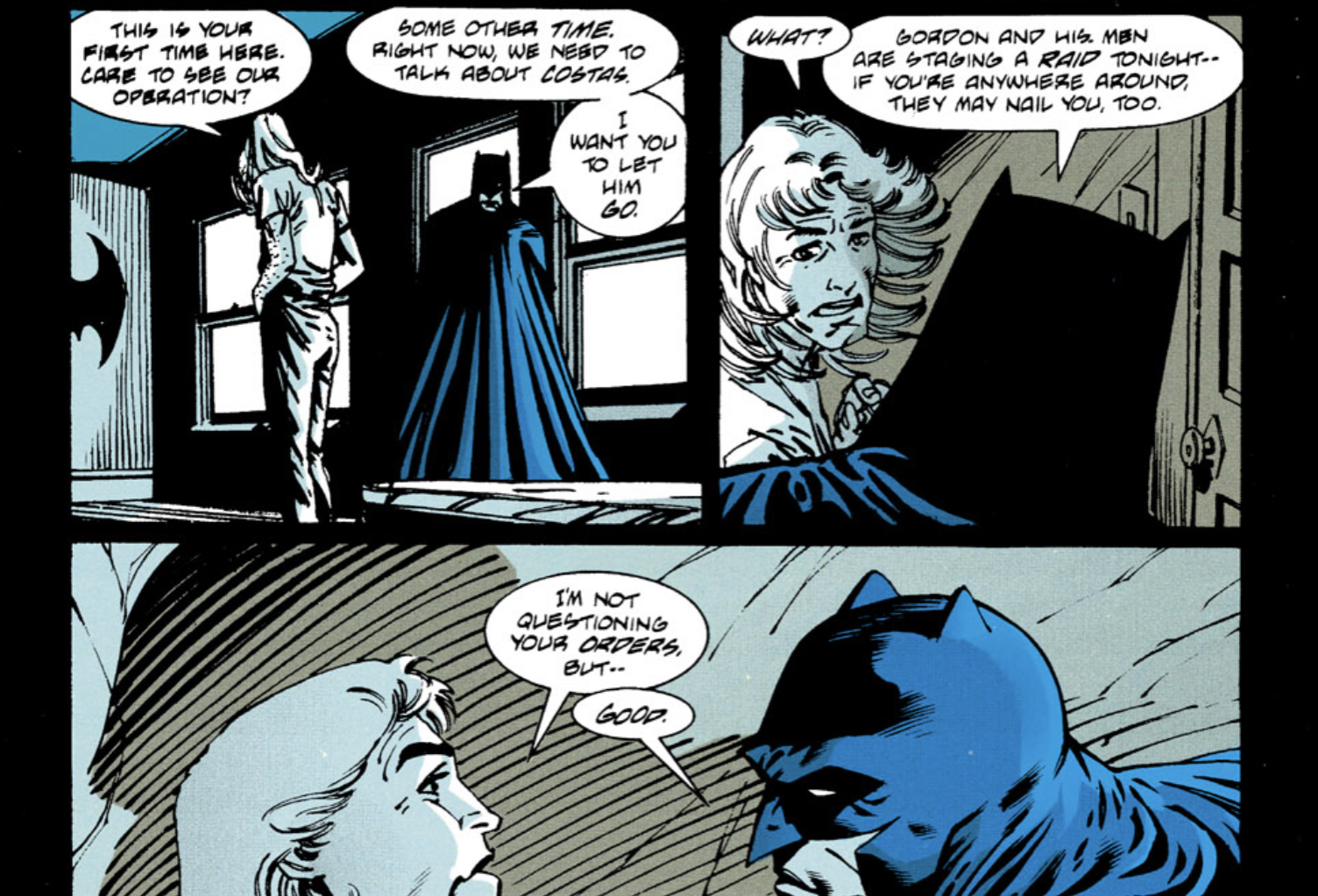
This all comes to mind as we consider “Faith,” a three-part story from Legends of the Dark Knight issues #21-23, with words by Mike Barr and pencils by Bart Sears. The “vigilante inspires other vigilantes” storyline is a leitmotif across Batman’s publishing history; in this scenario, it takes root within a former drug addict named John Ackers who overdoses, recovers, and then recruits some of his neighbors to build a Batman-inspired “gang” for positive change in the neighborhood. Unfortunately, John is also having some crazy visions (withdrawl-inspired?) about a giant fantastical Batman telling him to kill the guy who sold him the drugs that made him overdose. Batman has to juggle good intentions driven by insane hallucinations, and the bad behavior of the actual drug syndicate, along with the continuing efforts of the Gotham police to put him behind bars. Dr. Leslie Thompkins appears in a subplot where she learns that Bruce Wayne is Batman, forcing her to come to terms with her disdain for the vigilante and her maternal feelings for Bruce. 

I became aware of Bart Sears through his time penciling Justice League Europe; these three issues appear to have been published concurrently with his later issues on that series. This is likely to my own detriment but I always saw Sears as a “beefcake” artist, known for drawing outlandishly built men and women in tight-fitting spandex costumes. There’s certainly some of that here with regard to Batman, but I’m also struck by how effectively his elaborate, amplified style adapts to depicting mere mortals. I especially enjoy his version of the drug-addict-turned-community-activist John Ackers; he depicts him on a thin line between reality and exaggeration that allows for an easy transition between the character we see in the “real world” and the one contorted into unreality by his hallucinations. 
The publishing history of Batman hasn’t been dominated by the kind of Batman stories that seem most prevalent and popular today–big tales where teeth-gritting, endless loss, and villains constantly trying to destroy Gotham City are the order of the day. 

No, the vast majority of Batman stories are still relatively small, chronicling not the earth-shattering stories where “nothing will ever be the same” (until it is, eventually), but the ongoing adventures you’d expect from a guy in a bat suit who fights crime. Every night can’t destroy the status quo, otherwise there’d be no quo to status. Most nights are spent on the streets of Gotham, beating back an ever-breaking tide of superstitious, cowardly criminals who are relentless in their pursuit of the same sins and vices you’d see in any American city. Robbery. Bribery. Drugs. 

This is one of those smaller stories, character-driven, showcasing how the impact of the Bat can loom just as large on those he saves as it can on those he condemns. It’s a relief in some ways; a nice tight three-parter is a breath of fresh air after four consecutive five-issue stories (each of which could have probably been tightened into a four or three-issue affair, but I digress). 

Next: Chaykin, Kane, and “Flyer”

Alan Moore’s (Other) Batman Stories

Alan Moore has written a few Batman stories…none of which are really about Batman. He’s written stories in which Batman appears. 

His most famous (and notorious) Batman story, The Killing Joke, is really a Joker story. Batman’s a supporting character at best. Moore also deployed Batman to great effect in stories from both Swamp Thing and his famous Superman annual, “For the Man Who Has Everything.”

But Moore has two other Batman stories, one of which has never even been printed here in the United States, and isn’t comics at all. “The Gun” appeared in a 1985 UK Batman annual. It’s a prose short story by Moore with spot illustrations by Gary Leach, who draws a pretty sinister Batman. The titular weapon is (SPOILER) the gun that shot young Bruce Wayne’s parents, and it’s being utilized by Johnny Speculux, a graffiti-tagging thug with the most 80s British nickname in the history of the planet.

It’s one of those things where the weapon carries all this anger and rage which it then somehow mystically ejaculates through a variety of emissaries, including Joe Chill, before meeting its own demise eventually along with Mr. Speculux. Batman’s hardly in it, and when he is, it’s not a very distinct or inspired Batman. He has a nice short moment with a little girl who saw her own parents murdered by Speculux at an only-in-Gotham art exhibit of gigantic home furnishings (nice Dick Sprang homage there). 

Like Moore’s Star Wars stories for the UK Empire Strikes Back magazine, “The Gun” is clever and short. It’s a blunt instrument of a story, like something you’d read in 2000AD or even the EC books. It’s even got a “creepy” twist ending that brings the central theme of revenge back to its logical starting point, with Bruce Wayne as just another casualty caught in the crossfire. I very much liked this bit about Batman:

“He was staring at Johnny Speculux, and there was something familiar in his eyes…They had all of the seething, emotional intensity of a child’s eyes, but they were set into an adult’s face and the effect was terrifying.”

There’s something about little Bruce Wayne’s eyes living on in the visage of Batman; it’s a unique evocation of a theme that has since become trite, which is that Batman is little more than the seething wound left open by the death of Thomas and Martha. Back then, it wasn’t quite as overdone, and drawing our attention to Batman’s eyes puts us squarely in Johnny Speculux’s shoes, because while we don’t know that much about Johnny, we know everything about Batman’s vengeance, and we know it is a terrifying thing, even through the eyes of a child. 

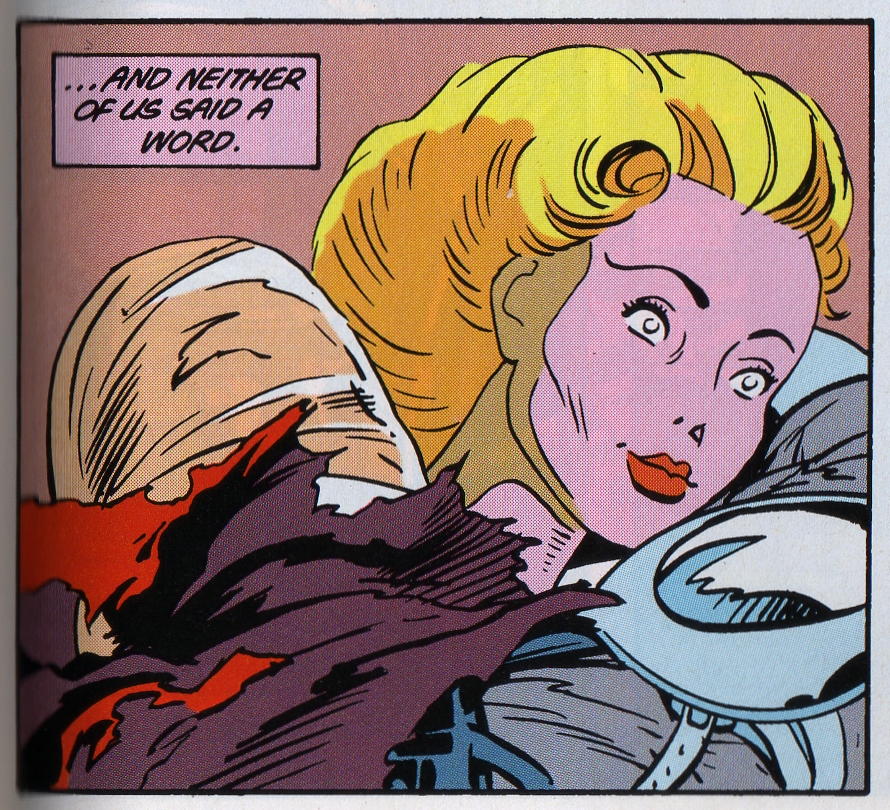
Moore’s other significant Batman story is from Batman Annual 11, “Mortal Clay,” with art by George Freeman. This one is a Clayface tale focused on the third villain to claim the title, Preston Payne. It’s a full-length comics story, not a four-page prose story, so Moore stretches out a bit and offers a glimpse inside the mind of a man obsessed with a mannequin. His “lover” is “Helene,” and the entire story is told from his point of view, so it becomes a series of cuckoldings in which a security guard and Batman both become “the other man” in his twisted brain.

Payne’s interior monologue is what provides the thruline for “Mortal Clay,” and there’s moments where Moore definitely lets the character ramble on, but it’s still a compelling narrative technique, especially since the comics format is so uniquely suited to utilizing voiceover and image to comment on each other. 

All you really need to know to get that he’s crazy is that Preston Payne is in love with a mannequin. Seeing it laid out as above, with “…and neither of us said a word” as counterpoint to the dead chilling face of “Helena,” is Moore mining the potential of comics for its full potential. 

So much of what I love about Moore comes down to his exceptional ability to pull off moments just like that one. He is a supreme master of comics as a unique storytelling vehicle–part prose, part image, part something else entirely. Whether it’s a minor moment of Clayface hugging a mannequin or the virtuoso construction of Watchmen’s fifth issue, where Moore and Gibbons together build a “Fearful Symmetry” into the DNA of the page layouts themselves, Moore is so completely comfortable with the multiple levels on which sequential art can operate that his stories always redeem multiple readings. Even when he’s just telling a Batman story that’s not much about Batman for a random annual, meant to do little more than pile onto the limitless and ever-growing mountain of ongoing superhero fiction. 

Batman himself doesn’t appear significantly until the final sequence of “Mortal Clay,” when he shows up to capture Clayface and is mistaken for the latest lover to steal the heart of “Helena.” Clayface and Batman fight, until Clayface collapses in a distressed heap before his mannequin, and Batman…offers his hand to the villain. 

We then learn that while Clayface has been restored to Arkham Asylum, thanks to Batman’s intervention, he’s been allowed to live in relative happiness with “Helena.” It’s a side of the Caped Crusader we don’t see very often these days, but it’s welcome when it does appear; Batman has pity and mercy for many of his sickest adversaries.

These handful of stories don’t give us a great idea of Moore’s vision for Batman, except that Batman functions solely as a supporting or inciting character in each tale. That’s a decision by itself, and it suggests Batman as a figure of menace and mystery. Even as Moore wrote his Batman stories decades ago, the Caped Crusader’s interior life was becoming somewhat over examined. Placing Batman as a secondary character in his own story allows Moore to focus on Batman’s milieu and examine the character as reflected through others. 

Of course, we could spend days dissecting the elements of Batman that inspired aspects of Rorschach from Watchmen… 

That’s the thing with Batman: Even if you’re Alan Moore, Batman’s never really far away.

Bats and Legends: “Venom”

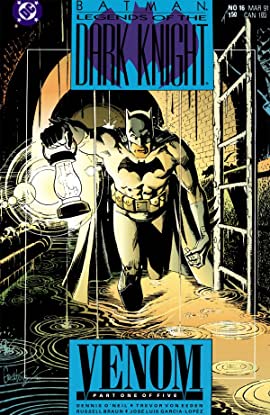
Just ten issues after his first storyline for Legends of the Dark Knight (“Shaman”), Denny O’Neil is back behind the word processor again for “Venom,” a five-parter with artists Trevor Von Eeden (layouts), Russell Braun (pencils) and the great Jose Luis Garcia Lopez (inks). 

That’s a murderers’ row of talent, and it’s a shame that the work doesn’t live up to their reputations. “Venom” is known today more for what it introduced into the DC Universe than for the story itself–the “venom” in question is the same narcotic cocktail that will create Bane, and this story brings the drug to Santa Prisca, a fictional South American country invented by O’Neil during his run on the Question. We will eventually learn that Bane hails from Santa Prisca, where he was forced as a child to serve time in a maximum-security prison because his dad escaped–the kind of insane version of “justice” only a mid-nineties comic book writer could come up with. 

“Venom” feels like a logline in search of a story, a character, a theme; anything to justify its existence beyond the simple high concept of “Batman gets hooked on performance-enhancing drugs.” It feels incredibly dated, its understanding of the illegal drug trade and its impact on the U.S. informed largely by the waning days of the first War on Drugs. Characters behave in ways that defy our previous understanding; Alfred functions solely as a long-suffering quip machine, his droll one-liners awkwardly punctuating even the most dramatic moments. 

There’s something lumbering and gawky about the way it’s plotted, too; you have this big fat hook, “this is your Batman…on drugs,” and then he overcomes the addiction by the end of the third issue in the story, just so that he has time to play the Schwarzenegger role in a warmed-over redo of Commando. You can see O’Neil is trying to build sympathy around the son of one of the story’s two villains, but his father is such a grotesque pantomime of “old Army dude practices tough love on his family” that it defies belief. 

Also beyond caricature is the “evil scientist” who creates “venom.” Batman’s inciting event in the story is the death of the scientist’s daughter in a drowning that Batman could have prevented if only he’d been physically stronger. When Batman appears to tell the scientist about the death of his daughter, the scientist barely reacts; within a few panels, Batman is taking the guy’s pills. It’s probably a bad idea to trust the pharmaceutical recommendations of a sociopath who can’t bother being upset about his young daughter’s death by drowning. 

Tegan O’Neil does a much better job of dismantling this arc than I could. “Venom” has been around long enough that it feels like a necessary evil, a bedrock of the modern Batman mythos that exists solely because it has to. It gave us the Venom drug, which begat Bane, which begat Knightfall and countless other Bane stories and eventually The Dark Knight Rises. In spite of its dated, cloying story and unrealistic characterizations, we’re probably stuck with it. 

Batman: The Detective #1-3 (Review)

It was probably an accident of publishing circumstance that resulted in Batman making his debut in a title called Detective Comics, but since that first appearance in 1939, Batman has been synonymous with detective work–investigation, interrogation, tracking clues and suspects, and then fitting all those pieces together into a complete picture. 

Those are some of my favorite Batman stories, because they underscore Batman’s humanity and brilliance. He can’t use X-ray vision to see through walls and spot things; he can’t race across town in an instant to catch a criminal in the act. He can observe and deduce, just like any of us could, and he’s very good at it. 

Tom Taylor and Andy Kubert have served up a decent Bat-mystery so far in their Batman: The Detective miniseries (issue 4 hits stands today, July 13). The six-issue mini takes place in what appears to be a future state moving toward Frank Miller’s Dark Knight Returns. That’s a bit of conjecture on my part, but the way Kubert draws Bruce Wayne seems to indicate this is a character moving toward the hunched, sinewy Batman that Miller envisioned for his take on the character’s last adventures. 

And Kubert…well, Kubert draws the hell out of it. I’m not sure what got us here, to Andy Kubert drawing a six-issue mini set in a possible future that has no great stakes for the wider DC Universe. But I am glad we’re here. Every issue has at least one drop-dead moment of kinetic glory–in issue 1, it’s this full-page rendering of Batman confronting a fully demonic Gentleman Ghost. 

Kubert is first and foremost a visual storyteller, so this isn’t just a showy moment; paired with tight scripting from Taylor, this is an essential beat in the issue. I love the lead-in dialogue from Batman on the preceding page: “Squire, I want you to walk toward me, and whatever you do…” It cleverly sets up the reveal and the stakes at the same time; Batman’s going to be fighting for his own life, but he’s also got to keep Squire safe. And give those squared-off blocky Bat-fingers a gander; that is very Miller by way of Jack Kirby. (In the story, they’re ghost-boxing gloves gifted to Batman by John Constantine, who won them in a poker game with a demon. That’s the DC universe I want to spend more time in–the one where Constantine wins ghost-boxing gloves in card games with demons, and gifts them to the Caped Crusader.) 

Taylor and Kubert succeed with Detective by layering on a series of subtle twists to the expected modern Batman detective storyline. It’s an older Batman; he’s transported to Europe so he’s out of his element; the mystery he’s wrapped into becomes as much about his earliest past as it is about his immediate present. I won’t spoil the central conceit of the story’s new villain but again, it’s a very clever scenario. 

There are tens of thousands of Batman stories and there will be tens of thousands more. This is a good one.

Bats and Legends: “Prey”

If you want, you can blame Bob Kane and Bill Finger. 

In November 1939, they published their origin story for Batman, in Detective Comics #33. It’s been 82 years, and the details haven’t changed much–Bruce Wayne leaves a theater with his mom and dad; a criminal holds them up with a gun, shooting his parents; he sits in a puddle of their blood and watches them die. This becomes his inciting event–the reason he dedicates himself to a life spent striking fear in the hearts of criminals as a bat. Also, man. A Bat-man, if you will. 

But really, it’s Frank Miller’s fault. Until his work in the 1980s, this story was an inciting incident for the Bat-mythos, but not the sole driving factor that made this dude dress up every night and get frothing angry at petty criminals. With Year One and The Dark Knight Returns, he paired Batman’s hypermasculine power with an almost infantile anguish over the death of Bruce Wayne’s parents. Not only did that create a cloud that has hung over Batman’s adventures ever since; it also has inspired hero after hero to develop their own parental issues, most often in the daddy department (Superman, the Flash, Iron Man, and so on). 

(It’s not that the death of Bruce’s parents wasn’t central to Batman’s mythology prior to Miller; it’s that it became popular to suggest it was practically the only relevant development in Bruce’s life prior to donning the cape and cowl. At one point in the seventies, writers seemed to be embracing a more magnanimous view of the Caped Crusader’s motivators; sure, losing his parents was an inciting event, but then Bruce got training from experts around the world and became inspired to dedicate his life to being a force for good in Gotham. Whereas the whole “PARENTS DEAAAAAD” vibe reads as more of an obsession than a vocation, and leads to all kinds of angst that somehow became hugely relatable to pimple-faced teenagers in the 90s and aughts, not unlike myself. ANYWAY.) 

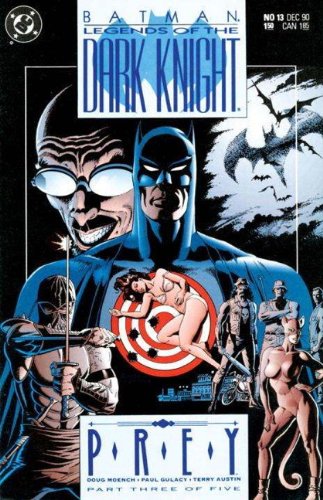
If you’re gonna dive into psychobabble with Batman, you almost have to pull the Hugo Strange card. (Joker’s up there too, of course, because lately all he does is prattle on about the nature of Batman’s obsessions and how he himself is the inevitable counterpoint/flip side of a dark, dangerous coin. But Strange has a Ph.D, so.) That’s exactly what Doug Moench and Paul Gulacy get up to in “Prey,” published in issues 11 through 15 of Legends of the Dark Knight in late 1990 and early 1991. 

As a story, “Prey” is a bit of a tangled mess. There’s Hugo Strange and Batman, and there’s Commissioner Gordon and a beautiful woman who is as underwritten as you’d expect. Catwoman has an extended cameo, and there’s a role for an overeager sergeant on the Gotham PD who becomes the Night Scourge, a competing vigilante, under the hypnotic thrall of Strange. 

Keeping all of these plot plates spinning requires Moench to paper over a few substantial leaps in the story; as obsessed as the overeager sergeant might be, do we really buy that a hint of hypnosis would turn him into a costumed crimefighter? Would we then also buy that he can hold his own against Catwoman and Batman in hand-to-hand combat? What about Hugo Strange himself donning a perverted Batman-esque costume for a breathy conversation with a lady mannequin to whom he seems inordinately attached? 

Again, the blueprint here is obvious–these are “year one” stories for Batman, so Moench takes his cues from Miller’s inciting work. There’s a Gordon/police storyline, a Hugo Strange storyline, a Batman storyline, and what amounts to a few scattered scenes of pinup Catwoman writhing in bed with her pets before she shows up to play a single impactful role in the overall story. 

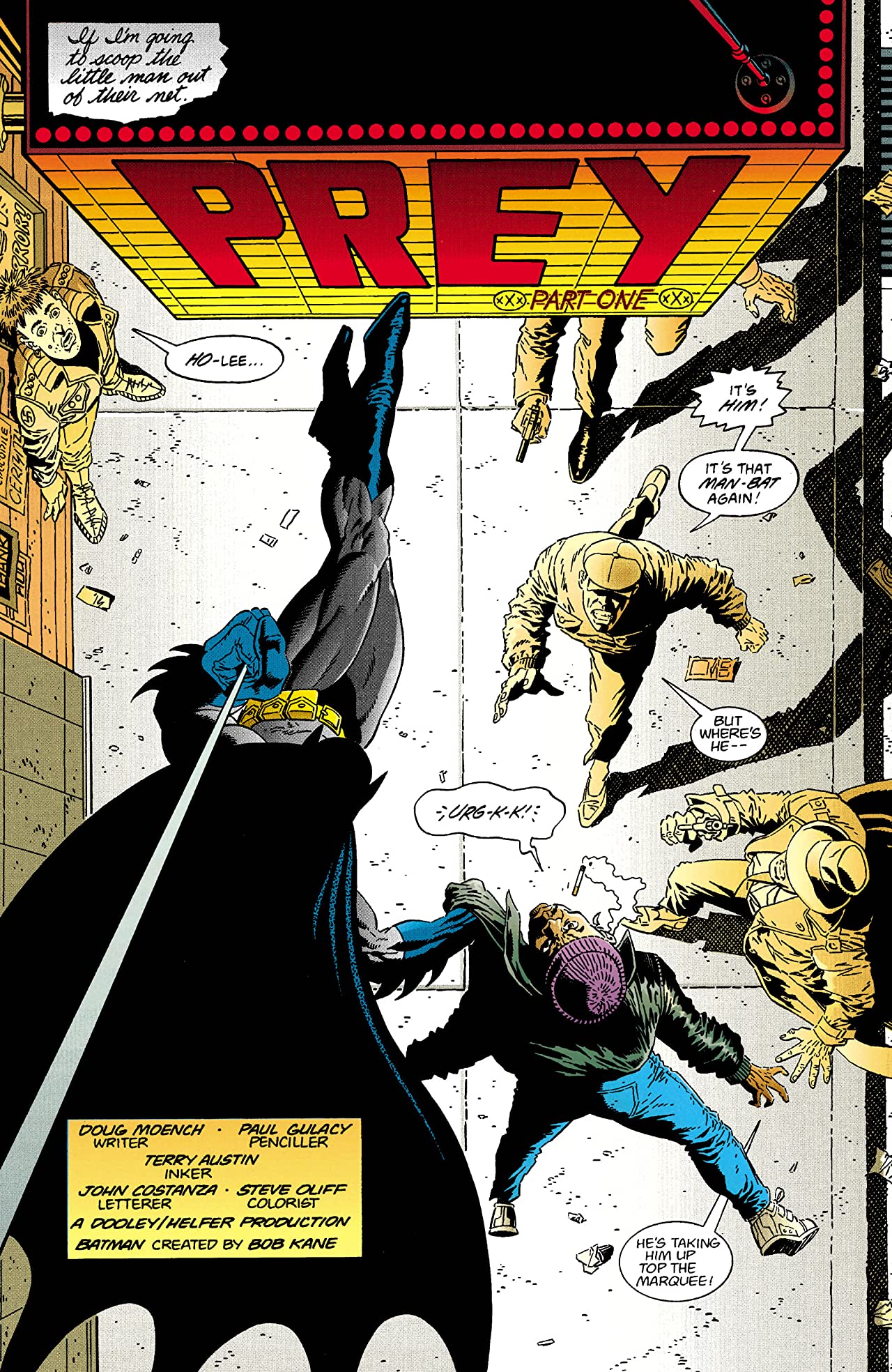
Moench feels like he’s checking items off a scorecard for this story, which is a shame, because Gulacy and inker Terry Austin deliver visuals with a heft and solidity that give their version of Gotham and its inhabitants a realistic gristle. Austin deploys shadow with care; paired with Steve Oliff’s colors, it creates a world that is dark, but not impossibly so. There’s enough light to make out color and shape; again, heightened but real. 

Moench does provide a splash of fanboy glee when he introduces the Batmobile to the “year one” era, in a design that’s inspired by Michael Keaton’s conveyance in the 1989 movie but not beholden to it. But moments like that are the exception rather than the rule, and unfortunately “Prey” loses its way pretty early to become wandering and listless.

***

Tegan O’Neil takes a more favorable view of “Prey” in this review from 2015.

Next: This is your Batman on drugs. Any questions?