Author Archives: Matt

I’ve Never Heard You Sing!

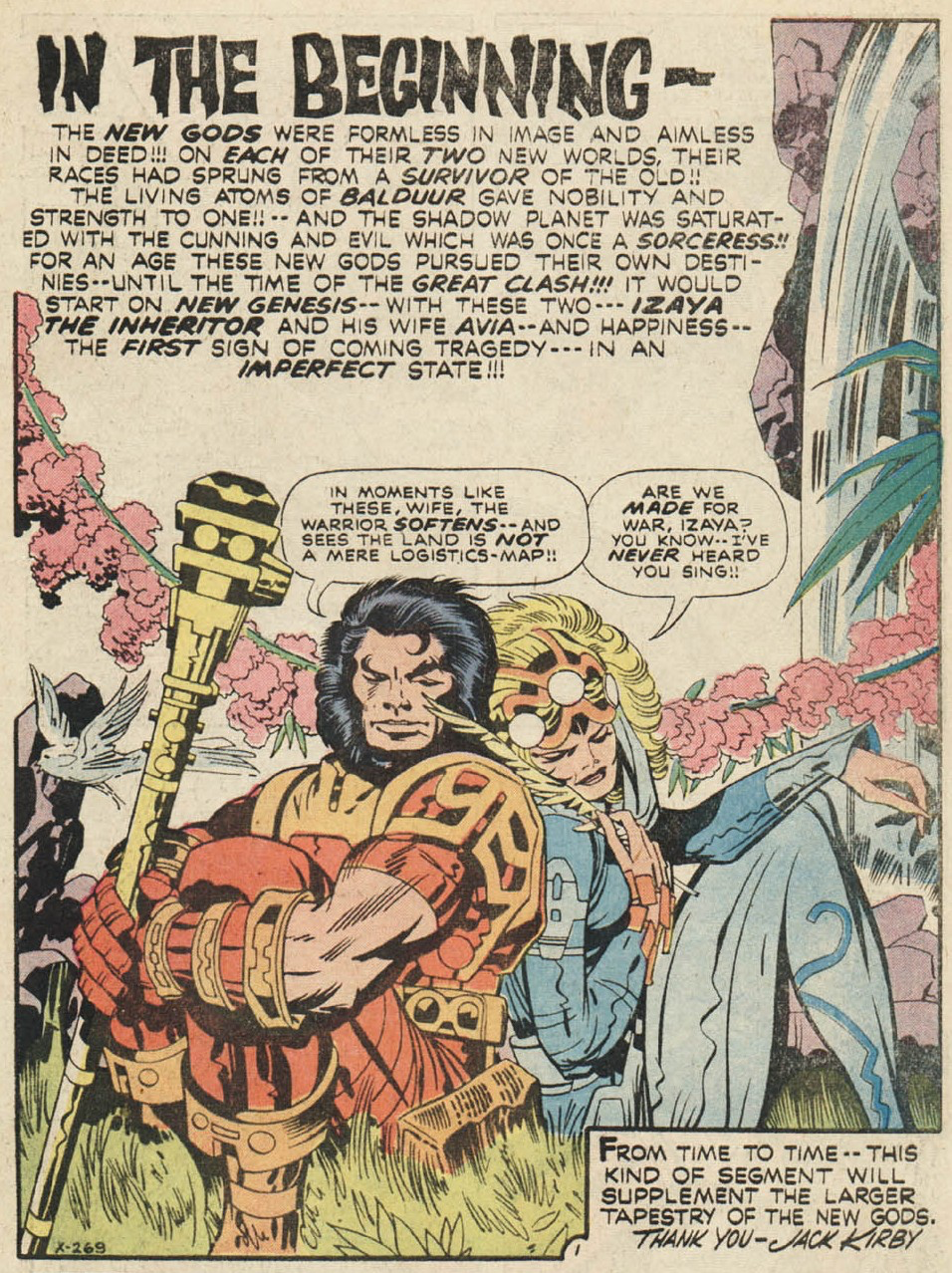
“Are we made for war, Izaya? You know–I’ve never heard you sing!”
–Jack Kirby, New Gods #7, 1972

There are things that MATTER, to each of us; and then there are things that don’t really matter but still matter. Social media is a constant push and pull between sharing all of those things, in ways that feel comfortable, and ideally without the classic Reply Guy emerging in your space to say “Well achtchuallyeah, that doesn’t matter at all” or “What matters to you matters so little to me, I will shit on it and then drift on with my life.” 

Don’t yuck my yum. We told our kids that and I think of it every day on social media. I work at home, I spend more time alone than is probably “healthy,” and I am trapped in my head too often. I have often looked to social media as a way to connect to the outside world in a way that’s meaningful, without having to prowl my city to find the one other dude who is both way into the new Rings of Power show on Amazon and the recorded works of Elvis Costello. 

When you put something out into social, and no one seems to notice, I guess that sucks? But when you put something out and the Reply Guys appear, it really sucks. But how else do you create interactions, if not to reply? And how else do you create dialogue if not to disagree? 

It’s a sticky wicket. 

Anyway, I’ve come around on Rings of Power in its second season, and I live in fear of mentioning it because I do not need an army of Reply Guys to tell me why Tolkien is rolling over in his grave, threatening to disrupt the prosthetic elf ears carefully glued to his corpse to honor his final wish. 

Overall I think I was a little iffy on season one. Maybe I was overly critical of it, or maybe it wasn’t as good? Looking back it does feel like a shitload of setup, how much was necessary?

But I am A Dense Man and so I will confess, it did not lock in for me until like S2E2 that this is basically the story of the prologue of the LOTR movies told in full. I guess for some crazy reason I assumed it was just trying to draw thin lines of plot thread out of all these appendices and whatever leftovers Amazon had the rights to. Realizing that this story “matters” to the stories I already know and love from the Peter Jackson movies immediately upped my interest.

As these tumbler pieces of plot and pathos click into place, I think the show has risen to the occasion. it’s been incredible watching Annatar/Sauron slowly seduce Celebrimbor, and then leave him hanging as a broken betrayed man completely suckered by ego. As Annatar/Sauron, Charlie Vickers is delivering a performance for the ages. Fully revealed to the audience as the embodiment of manipulative evil, his every glance and gesture is carefully measured. His arm is touched with gentle intent and he struggles not to destroy whoever is attached to the kind hand. His contempt is always barely contained, his true power carefully concealed until it benefits him to use it. 

And there are moments that stand in the same company as Jackson’s LOTR films, although I’d not dare to suggest they’re “better.” The siege of Eregion presented in S2E7 feels tactile and brutal in ways that television typically does not achieve. There’s real scale in it; watching the short “making of” featurettes after each episode, you can actually see they’re going to real places for some of this stuff. There’s plenty of CGI and plenty of it looks a little crappy, but there’s moments where the CGI is enriching and supplementing something originally shot practically, and those moments carry unexpected weight. 

I’ve tried at least three times to read the Lord of the Rings novels and failed. (I did read the Hobbit often as a kid.) I’m not really a Toliken guy, but I’ll court the fury of some Reply Guy somewhere and suggest that while I can’t say if this is “faithful” to Tolkien’s work, this does feel like something he would have come up with. If he were still alive, and the LOTR movies made a shitload of money, and they paid him dumptrucks full of gold to develop a prequel, this feels like something he might have approved. 

And if not, who cares? Are we made for the onslaught of Reply Guys? I’m enjoying it. And that doesn’t MATTER to me, but it matters, so I’m eager to discuss it, but wary of the yuck to my yum. So it goes.
Bats and Legends: “Destroyer”

“Comics will break your heart,” or so the saying goes, and while I’ve never had my work exploited for a billion-dollar movie franchise or had to beg a publisher to pay my invoice so I could cover rent, I have had a few little heartbreaks, here and there, over the years. 

This issue of Legends of the Dark Knight was surely one of the first–a title seemingly created to tell stand-alone stories over several issues from the early days of Batman’s career, suddenly shoved into a three-part crossover with Batman and Detective Comics. Sure, I was buying all three titles, that’s not the point. The point is that when faced with any decision pitting creative value over additional revenue, comics publishers will always choose the latter. 

This will only become more horrifying as we get into the era of Knightfall and KnightsQuest and KnightSweats, all those gigantic storylines that pull in every single Batman series to tell a big stupid saga. Heaven forbid one Batman title get left alone to serve as antidote to an era of endless cash-grab crossovers. 

Like I said, I was a teenage Batfreak who bought all these issues slavishly when they came out, so I had all three parts teed up in Ye Olde Longboxes. It’s an interesting story because Alan Grant, who was all over the Batman books in that era, writes parts one and three, leaving dependable Denny O’Neil to pen this middle chapter. On pencils, we get Breyfogle and Aparo on the other titles, and none other than…Chris Sprouse on this issue. 

That’s right–it’s a Dennis O’Neil script drawn by Chris Sprouse, and it’s plopped in the middle of a three-part crossover story designed to give some love and possibly publishing fees to Anton Furst, the production designer whose vision of Gotham City animated the two Burton Batman films. 

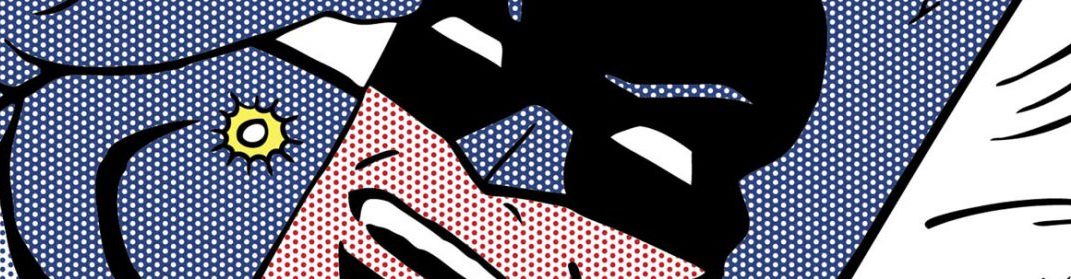
Based on the checklist at his website, this was in the earliest days of Sprouse’s penciling career. (I forgot he drew a Batman annual written by Andrew Helfer, which I will have to check out.) What’s great about it is that it is immediately recognizable as Sprouse; he apparently didn’t have to suffer through a period in his early career where he was asked to adapt to a DC “house style.” And from the jump, Sprouse’s Batman is terrific. He leaves the eyes white, creating an extra emphasis on Batman’s facial expressions. Look at this somewhat surprised Batman. 

He doesn’t overdo it; it’s not exaggerated. But leaving those eyes without detail forces us as readers to rely upon the rest of Batman’s expression to interpret his mood–alert, engaged, slightly taken aback. 

There’s not a lot of big visual moments in the issue, other than a terrific page where Sprouse depicts the Wayne Foundation building collapsing thanks to a criminal’s bombs. 

Three vertical panels, perfectly visualizing the entire point of the conflict in the story–a crazed architecture freak who destroys newer buildings in Gotham so that the city’s oldest gothic facades are more visible. 

Perhaps in a nod to the title’s intent, O’Neil does include a backward-facing moment where a flashback illustrates the Wayne family’s connection to the architectural style Gotham has developed as its trademark–which happens to be the same style Furst imagined for Gotham in his designs for the first two Batman movies. Beyond that, this is not a complicated story, although it is clever. The motivation of a villain who sidesteps his way into manslaughter by way of his passion for architecture is something different, and it connects well to the inclusion of Furst’s designs, which was definitely meant to capitalize on the ongoing Bat-fever as a world waited with breath bated for the premiere of Batman Returns in June 1992. 

I enjoyed these three issues, both at the time and upon a re-read nearly thirty years later. And yet, I can’t help but recall how this moment also marked the beginning of the end for my illusions about comics. Sure, I’d happily lapped up the 1991 annuals to follow Armageddon 2001, but mess with Batman, and you’re crossing a line. 

Next: Matt Wagner and “Faces”

On Grant Morrison’s Batman, A Decade Late

Batman never dies.

That’s not to say he will live forever. Comparatively speaking, “never dying” is a far more intense proposition. Cheating death, dodging the reaper, time and again–that takes something special. 

One of the many things Grant Morrison’s Batman run is “about” is this idea–that Batman never dies. It’s there in the opening pages of Batman #676 (June 2008), and it’s there in the closing pages of Batman Incorporated #13 (September 2013). 

There’s plenty of ways to “read” that idea, from the beautiful to the profane. Batman never dies because that spirit of justice in the dark can never be allowed to die. Kill a Batman and another rises to take his place. The concept is too powerful. 

Or “Batman” is just an aging container of IP that can never stop but must always somehow stand still. Should this Batman really die, he would take whole corporations with him, revenue, jobs–he’s his own economy. Batman never dies because he can’t; his movies, comic books, video games, TV shows, bath towels and action figures are too lucrative. 

Interpret it as you will; it remains true regardless. Batman never dies. 

I have really fond memories of Grant Morrison’s Batman run, but I lost the thread around the start of Batman, Incorporated. Those early to middle days of the sprawling storyline were heady with speculation and chatter, which felt like part of the point; like Lost, a TV show where the stories that sprang up around it became part of its reason to exist, Morrison’s Batman tale invited deep examination. He had staked a claim on a powerful central idea–all Batman stories are true–and that made it seem as though anything was possible. 

This weekend, I finally caught up with the end of the story, eight years too late, and that concept continues to shine on–in those pages, anything is possible. It all happened. Everything is true.  

(Of course, the only reason everything can be true for Batman is that none of it is true; it’s all stories. This is an imaginary tale…but then again, aren’t they all?) 

Morrison has been exploring the “meta” surrounding comics for decades, since back when he himself peered out from the pages of his Animal Man run. The speculation about his Batman stories–experienced mostly by me online, although I’m sure there were heady conversations that sprung up at plenty of comic shops and convention bar scenes–it all drew inspiration from Morrison’s work but became its own network of references and possibilities, built up around the books, dependant upon them to exist but not to grow. 

It became another way for everything to be true, although Morrison wasn’t so coy as to suggest that every possible theory from a small army of brilliant annotators and speculators was theoretically possible. He put stakes in the ground throughout his saga; beats and ideas from the earliest issues impossibly gained fresh relevance five or six years after their introduction. There’s a plot in the middle of it all, and although it’s rarely a straight line, you can recognize it. 

But it’s not always easy. Later-era Morrison superbooks have this puzzling habit of…missing plot chunks? I don’t know how else to describe it. It’s like every scene that feels like it should explain something starts right after the explanation happened. Answers to unasked questions surface as asides in scenes ostensibly about something else. Villains monologue but only to eloquently overstate their commitment to Morrison’s overarching ideas. 

It’s a feature, not a bug. It’s a form of misdirection, for one thing; it’s amazing the creative twists he can get up to when you’re distracted by a tactical bit of story business. 

It’s also a clever way for Morrison to have his cake and eat it too, which is ultimately the point. While everything may have happened to Batman, only some of it matters.

As a writer, he makes those choices with every panel; as readers, we do too. Within the story itself, Batman has to face this challenge throughout Morrison’s run–almost as though Morrison is the metavillain behind it all, pulling these old tales out of back issue bins and shoving them into Batman’s face. Almost every plot twist, story arc, or new character demands that Batman reach back through his infinite library of case files and uncover some unexpected connection. 

Everything has happened to Batman, and he never dies. But he decides what matters, and he chooses to live. Every time. That’s the animating force of Batman as a superhero and a person, and it’s what brings us back to the character, time and again. He is in a constant state of preparation and reaction, but through it all, he has a center–helping others and protecting his chosen family. This may have started for him with a hole in things, and maybe that hole will always gape in his deepest self. Ultimately, in Morrison’s run, he learns he’s at his best when he’s not focused on that hole in himself but on how he can help others. 

Batman never dies, but we do. We’re dying now, and we will die someday. For us, it’s even more important to choose what matters. That’s our straitjacket, and that’s our open door. 

Bats and Legends: “Flyer”

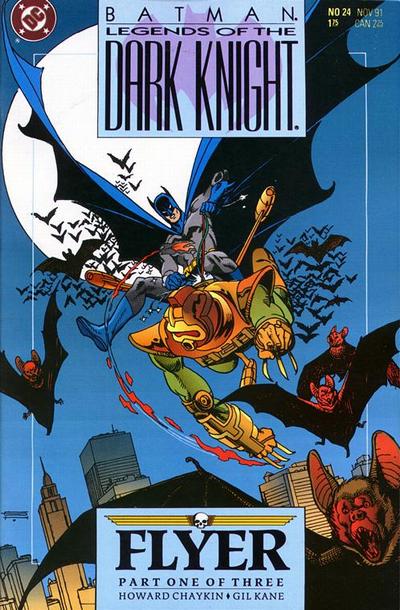
There’s a heightened sense of expectation when a comics fan sees the words “Chaykin” and “Kane” on the cover of an issue. (I guess it depends on the “Kane” in question; I’m talking about Gil, not Bob.) 

These are not only two masters of the form, but each known for their own distinct approach to comics–as a writer, Chaykin excels at a steamy blend of intrigue, sex, politics and satire; Kane’s pencils are legendary for their mastery of shape and shadow. 

Not only are these two greats working together, but they’re doing an out-of-continuity Batman story. DAMN. This should be good, right? 

No. No, it’s not. 

Chaykin picks a fine starting point for his story–Bruce Wayne worried he’s enjoying being Batman a little too much, until a mysterious foe in a flying armored war machine attacks him unexpectedly and leads him on an aerial chase high above Gotham City. That’s essentially part 1 of 3 here, and if you’re curious enough about what you’ve heard so far to want to check this out, maybe only read the first part. 

From there, Chaykin twists this story into something grotesque involving Nazis, intimations of incest, and a set of brutal characters that might seem worthy of our pity if they weren’t so unlikable. Our finale entails Batman held captive by Birgit Eisenmann, an ageless Nazi crone who is obsessed with procreating with the Caped Crusader to further her personal vision of a “master race.” 

This one line from the DC Database entry on the issue really captures the squirm of it all: “Birgit gets aroused watching Batman overcome every obstacle…” These are elements of plot and character that could just as easily have been assembled into something more sturdy; Chaykin has written plenty of genre stories where moments of revulsion are employed not just for shock value, but for thematic resonance or even just bizarre humor. Here, these strange villains seem to come from nowhere, say nothing, and vanish just as quickly as they appeared. 

“Flyer” is…an uncomfortable read. Because it feels both silly and gross at the same time, what stands out are some of the more ludicrous comic book plot devices Chaykin employs. Early on, Batman knocks the flying Nazi into the river, causing him to almost drown; in response, he brings the dying criminal to the Batcave (?!!?!) to work with Alfred on saving his life. If Batman started bringing bad guys he hurt to his secret headquarters, it wouldn’t stay secret for long. 

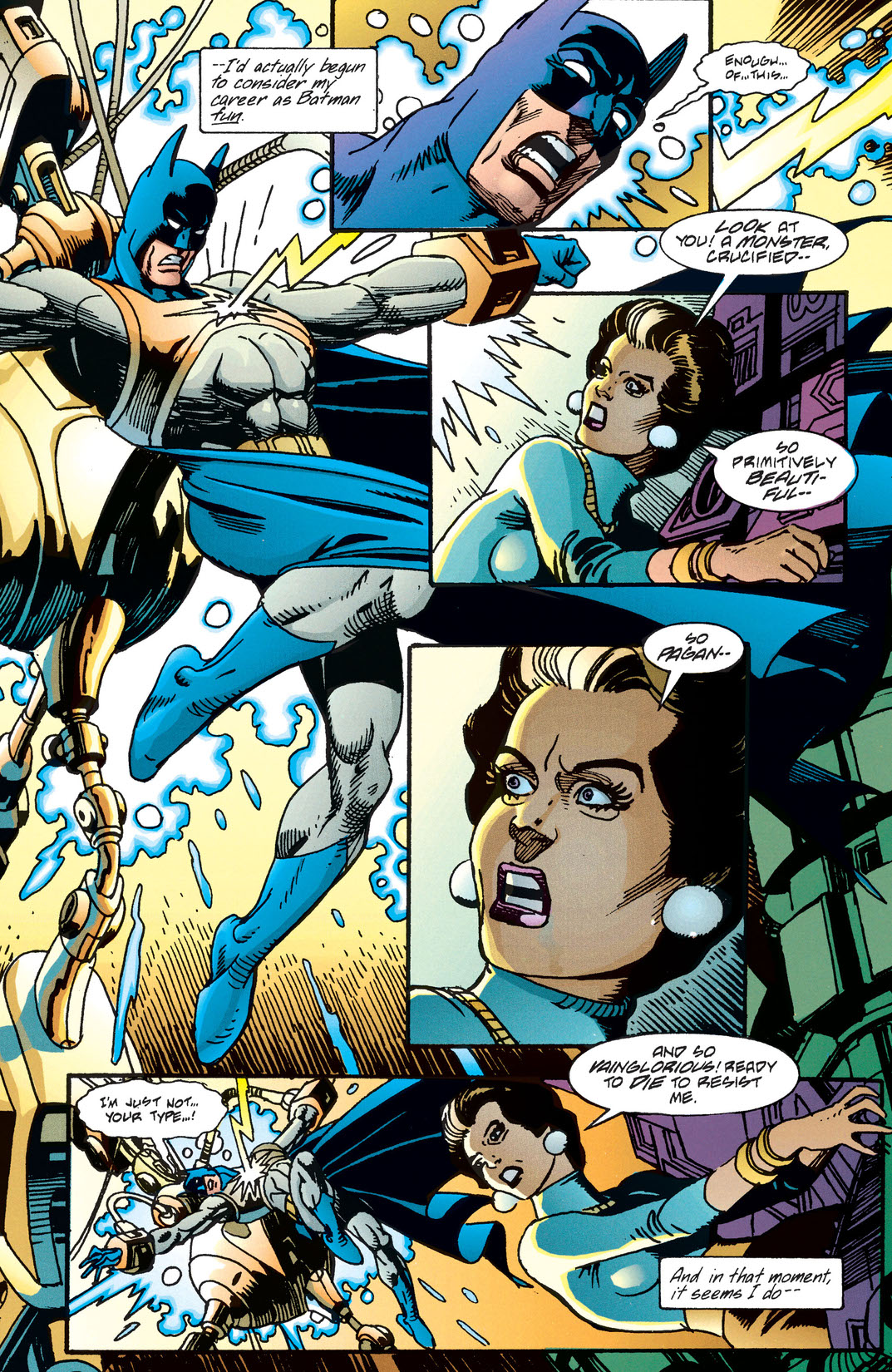
All of that said, there are some late-era Kane pages here that are gorgeous, even if they’re in service to a story that’s at turns stupid and disturbing, and occasionally both at the same time. 

I love the motion of the cape here and the position of Batman’s legs, as they emphasize both the power Batman’s fighting against and his body’s struggle in opposing it. The three facial close-ups on the right-hand side help escalate the drama as well–Batman’s anguish, followed by a two-panel zoom into Birgit’s mania. 

“Flyer” feels like a classic example of the “adult” comic book story gone woefully wrong; it’s not enough to put Batman into a story with weird sex stuff and the most toxic foes imaginable (Nazis). If it all pushes the reader away, if there’s nothing smart or emotionally engaging or even formally interesting, then there’s no point.

Ten Reasons Why You’re Stupid If You Think Bruce Wayne Should Use Money To Save The World

Could the answer to Gotham's problems be to "defund Batman"?
  1. Do you have any examples handy (fictional or otherwise) of other rich people who’ve used their money to just solve a problem outright? How’d that work out for them? 
  2. Let’s say Bruce Wayne was able to somehow use money to stop crime in Gotham City. No Batman, no weirdo surveillance state with robots, just a shitload of money thrown at a well-considered public safety strategy that focuses on the root causes of crime rather than ongoing escalation of tension through armaments and violence. You don’t want a Batman story; you want something else. Go find it, or if it doesn’t exist yet, write it. 
  3. I’m not an economist but even if Bruce Wayne is now a capitol-B “Billionaire,” it’s hard to imagine how he could pay to eliminate crime in such a way that it lasts for any reasonable amount of time. Maybe he funds some kind of annuity that just keeps tossing off dividends and interest to fund this project for years or decades? Is that even possible? 
  4. Let’s say he eliminates crime. Crime no longer exists in Gotham City. What about the suburbs? What about the counties next door? Is he building some kind of fortified city-state in the middle of America? Cause if he isn’t, I guarantee there’s plenty of crime happy to be bussed into Gotham to test its new public safety strategy. 
  5. Crime is gone in Gotham. What about homelessness? Poverty? Education? Crisis readiness? A pandemic? A natural disaster? Infrastructure? How do you pay for one or two of those things and then not wonder what the fuck happens to the other ones? Does eliminating any one of the Big Societal Problems Facing A Major American City somehow make the others evaporate too? 
  6. You can do a lot with Batman, but at their heart, most of the best Batman stories function at a level percolating just a couple inches above hot pulp garbage. This is a superhuman (but still human!) fantasy, revenge porn, escapist violence, whatever you want to call it or whatever about it gets you off. I can’t think of a single great Batman story that somehow manages to intellectualize its approach to the character and then somehow emerge on the other side with the visceral thrills of a guy in a bat costume punching a bad person in the face hard. 
    1. “What about Christopher Nolan’s trilogy?” Okay, that’s the closest I’ve seen, too. But I don’t know if it fully manages to succeed, or just creates enough of an intellectual landscape around it to make the punching seem thoughtful and mature. Lots of modern superhero stories use dumb ideas to playact as incisive social commentary. 
  7. If the idea is to create Gotham as a utopia where there is no crime, and then depict that utopia torn apart by crime that can’t be stopped, then I guess that’s mildly interesting? But the prior state that Batman/Bruce Wayne is yearning for can’t be a peaceful, happy Gotham. It’s always his parents. His inciting event isn’t that Gotham is a shithole; it’s that a criminal in Gotham killed his parents. Batman is trying to return to a moment when they were in his life, or when he knew the safety of their presence; he’s not trying to fix Gotham. That’s not something he really wants, whether he realizes it or not. 
  8. And if Bruce Wayne “fixes” Gotham, it’s not going to make him feel better. It’s not going to quiet his inner rage or fill the parent-shaped hole in his heart. Maybe he becomes obsessed with using money to solve problems instead of beating up criminals? Maybe that makes him realize he should just go beat up criminals because it feels better? But then it’s just ultimately a long road to a Batman story, when your boy could have been beating up bad guys from the jump. (And if he DOES feel better after using money to solve societal problems in Gotham, then please refer back to number 2. That character is not Batman or Bruce Wayne. Make your own dude.) 
  9. There’s often a political agenda behind this idea, as though Bruce Wayne should not only use his money instead of his bitchin’ badass Batcostume and persona to save Gotham, but should do it to adhere to a specific political point of view. Batman is apolitical. He beats the shit out of criminals. That’s his appeal and his limitation. 
  10. The real question here is this: Does Batman act out of service to a greater good, or does he act out of selfish vengeful gratification? I think he does both, but the balance is always a little skewed toward the vengeance. So this idea that Bruce Wayne would realize he could do more good with his money than with a Batarang? It would never, ever even occur to him.