If you want, you can blame Bob Kane and Bill Finger.
In November 1939, they published their origin story for Batman, in Detective Comics #33. It’s been 82 years, and the details haven’t changed much–Bruce Wayne leaves a theater with his mom and dad; a criminal holds them up with a gun, shooting his parents; he sits in a puddle of their blood and watches them die. This becomes his inciting event–the reason he dedicates himself to a life spent striking fear in the hearts of criminals as a bat. Also, man. A Bat-man, if you will.
But really, it’s Frank Miller’s fault. Until his work in the 1980s, this story was an inciting incident for the Bat-mythos, but not the sole driving factor that made this dude dress up every night and get frothing angry at petty criminals. With Year One and The Dark Knight Returns, he paired Batman’s hypermasculine power with an almost infantile anguish over the death of Bruce Wayne’s parents. Not only did that create a cloud that has hung over Batman’s adventures ever since; it also has inspired hero after hero to develop their own parental issues, most often in the daddy department (Superman, the Flash, Iron Man, and so on).
(It’s not that the death of Bruce’s parents wasn’t central to Batman’s mythology prior to Miller; it’s that it became popular to suggest it was practically the only relevant development in Bruce’s life prior to donning the cape and cowl. At one point in the seventies, writers seemed to be embracing a more magnanimous view of the Caped Crusader’s motivators; sure, losing his parents was an inciting event, but then Bruce got training from experts around the world and became inspired to dedicate his life to being a force for good in Gotham. Whereas the whole “PARENTS DEAAAAAD” vibe reads as more of an obsession than a vocation, and leads to all kinds of angst that somehow became hugely relatable to pimple-faced teenagers in the 90s and aughts, not unlike myself. ANYWAY.)

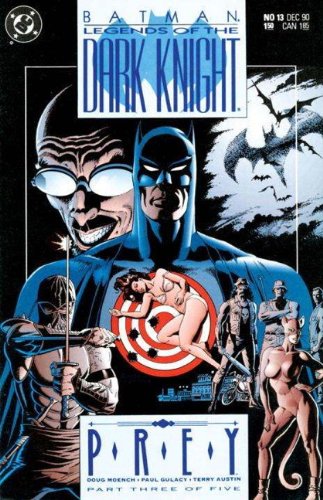
If you’re gonna dive into psychobabble with Batman, you almost have to pull the Hugo Strange card. (Joker’s up there too, of course, because lately all he does is prattle on about the nature of Batman’s obsessions and how he himself is the inevitable counterpoint/flip side of a dark, dangerous coin. But Strange has a Ph.D, so.) That’s exactly what Doug Moench and Paul Gulacy get up to in “Prey,” published in issues 11 through 15 of Legends of the Dark Knight in late 1990 and early 1991.
As a story, “Prey” is a bit of a tangled mess. There’s Hugo Strange and Batman, and there’s Commissioner Gordon and a beautiful woman who is as underwritten as you’d expect. Catwoman has an extended cameo, and there’s a role for an overeager sergeant on the Gotham PD who becomes the Night Scourge, a competing vigilante, under the hypnotic thrall of Strange.
Keeping all of these plot plates spinning requires Moench to paper over a few substantial leaps in the story; as obsessed as the overeager sergeant might be, do we really buy that a hint of hypnosis would turn him into a costumed crimefighter? Would we then also buy that he can hold his own against Catwoman and Batman in hand-to-hand combat? What about Hugo Strange himself donning a perverted Batman-esque costume for a breathy conversation with a lady mannequin to whom he seems inordinately attached?
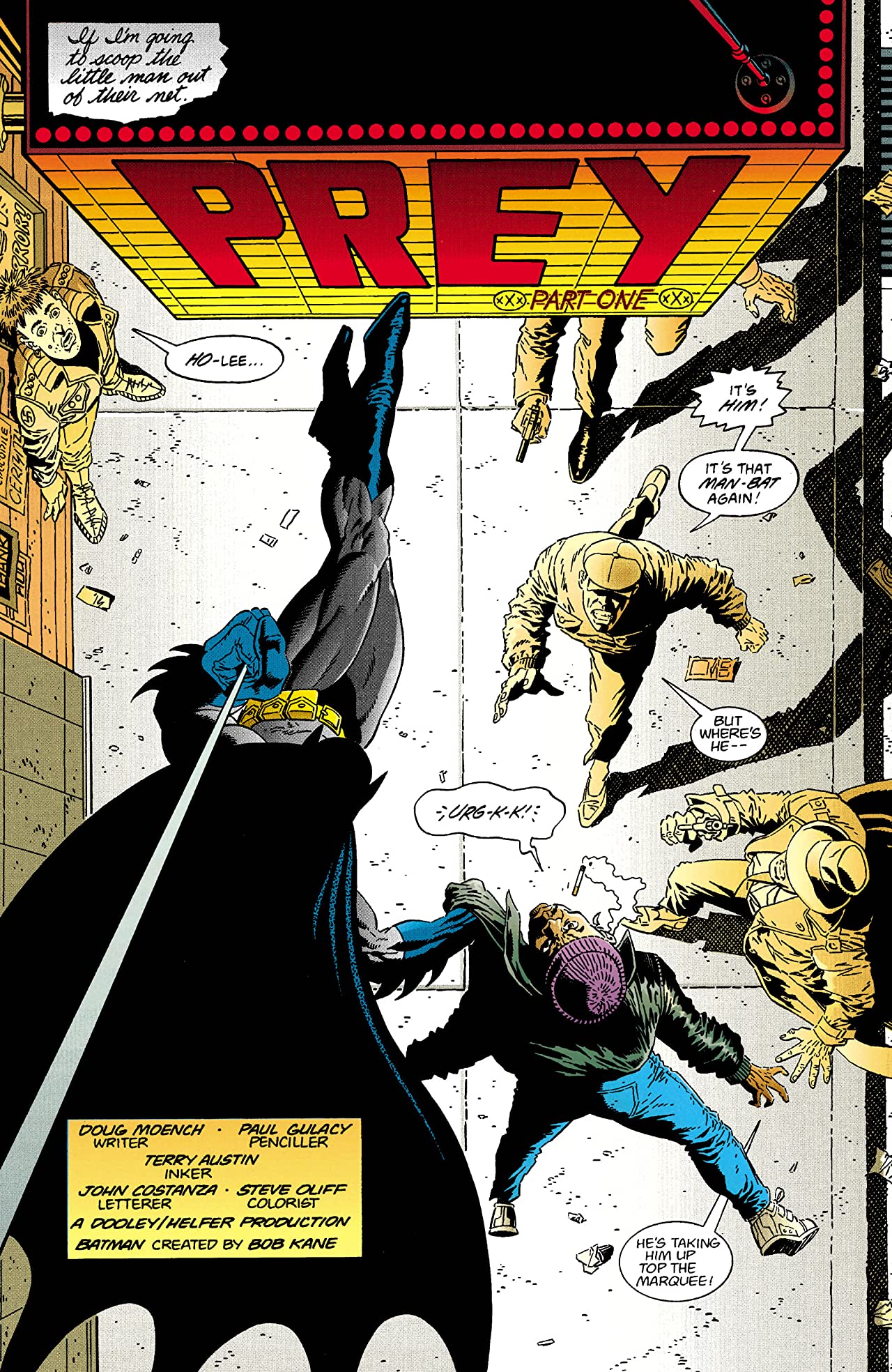
Again, the blueprint here is obvious–these are “year one” stories for Batman, so Moench takes his cues from Miller’s inciting work. There’s a Gordon/police storyline, a Hugo Strange storyline, a Batman storyline, and what amounts to a few scattered scenes of pinup Catwoman writhing in bed with her pets before she shows up to play a single impactful role in the overall story.
Moench feels like he’s checking items off a scorecard for this story, which is a shame, because Gulacy and inker Terry Austin deliver visuals with a heft and solidity that give their version of Gotham and its inhabitants a realistic gristle. Austin deploys shadow with care; paired with Steve Oliff’s colors, it creates a world that is dark, but not impossibly so. There’s enough light to make out color and shape; again, heightened but real.
Moench does provide a splash of fanboy glee when he introduces the Batmobile to the “year one” era, in a design that’s inspired by Michael Keaton’s conveyance in the 1989 movie but not beholden to it. But moments like that are the exception rather than the rule, and unfortunately “Prey” loses its way pretty early to become wandering and listless.
***
Tegan O’Neil takes a more favorable view of “Prey” in this review from 2015.
Next: This is your Batman on drugs. Any questions?


 Oonta Goota