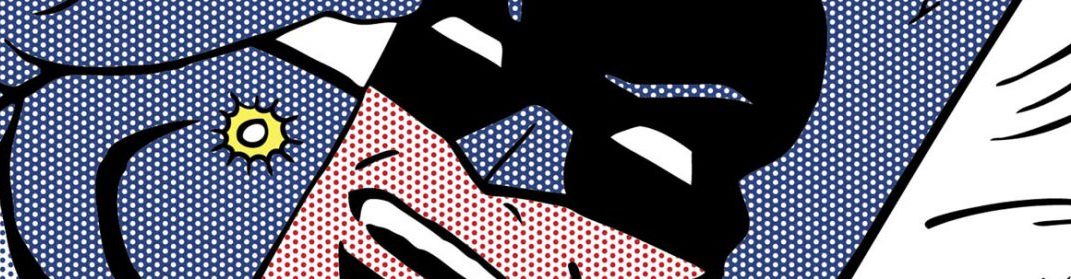
Alan Moore has written a few Batman stories…none of which are really about Batman. He’s written stories in which Batman appears.
His most famous (and notorious) Batman story, The Killing Joke, is really a Joker story. Batman’s a supporting character at best. Moore also deployed Batman to great effect in stories from both Swamp Thing and his famous Superman annual, “For the Man Who Has Everything.”
But Moore has two other Batman stories, one of which has never even been printed here in the United States, and isn’t comics at all. “The Gun” appeared in a 1985 UK Batman annual. It’s a prose short story by Moore with spot illustrations by Gary Leach, who draws a pretty sinister Batman. The titular weapon is (SPOILER) the gun that shot young Bruce Wayne’s parents, and it’s being utilized by Johnny Speculux, a graffiti-tagging thug with the most 80s British nickname in the history of the planet.

It’s one of those things where the weapon carries all this anger and rage which it then somehow mystically ejaculates through a variety of emissaries, including Joe Chill, before meeting its own demise eventually along with Mr. Speculux. Batman’s hardly in it, and when he is, it’s not a very distinct or inspired Batman. He has a nice short moment with a little girl who saw her own parents murdered by Speculux at an only-in-Gotham art exhibit of gigantic home furnishings (nice Dick Sprang homage there).
Like Moore’s Star Wars stories for the UK Empire Strikes Back magazine, “The Gun” is clever and short. It’s a blunt instrument of a story, like something you’d read in 2000AD or even the EC books. It’s even got a “creepy” twist ending that brings the central theme of revenge back to its logical starting point, with Bruce Wayne as just another casualty caught in the crossfire. I very much liked this bit about Batman:
“He was staring at Johnny Speculux, and there was something familiar in his eyes…They had all of the seething, emotional intensity of a child’s eyes, but they were set into an adult’s face and the effect was terrifying.”
There’s something about little Bruce Wayne’s eyes living on in the visage of Batman; it’s a unique evocation of a theme that has since become trite, which is that Batman is little more than the seething wound left open by the death of Thomas and Martha. Back then, it wasn’t quite as overdone, and drawing our attention to Batman’s eyes puts us squarely in Johnny Speculux’s shoes, because while we don’t know that much about Johnny, we know everything about Batman’s vengeance, and we know it is a terrifying thing, even through the eyes of a child.
Moore’s other significant Batman story is from Batman Annual 11, “Mortal Clay,” with art by George Freeman. This one is a Clayface tale focused on the third villain to claim the title, Preston Payne. It’s a full-length comics story, not a four-page prose story, so Moore stretches out a bit and offers a glimpse inside the mind of a man obsessed with a mannequin. His “lover” is “Helene,” and the entire story is told from his point of view, so it becomes a series of cuckoldings in which a security guard and Batman both become “the other man” in his twisted brain.
Payne’s interior monologue is what provides the thruline for “Mortal Clay,” and there’s moments where Moore definitely lets the character ramble on, but it’s still a compelling narrative technique, especially since the comics format is so uniquely suited to utilizing voiceover and image to comment on each other.
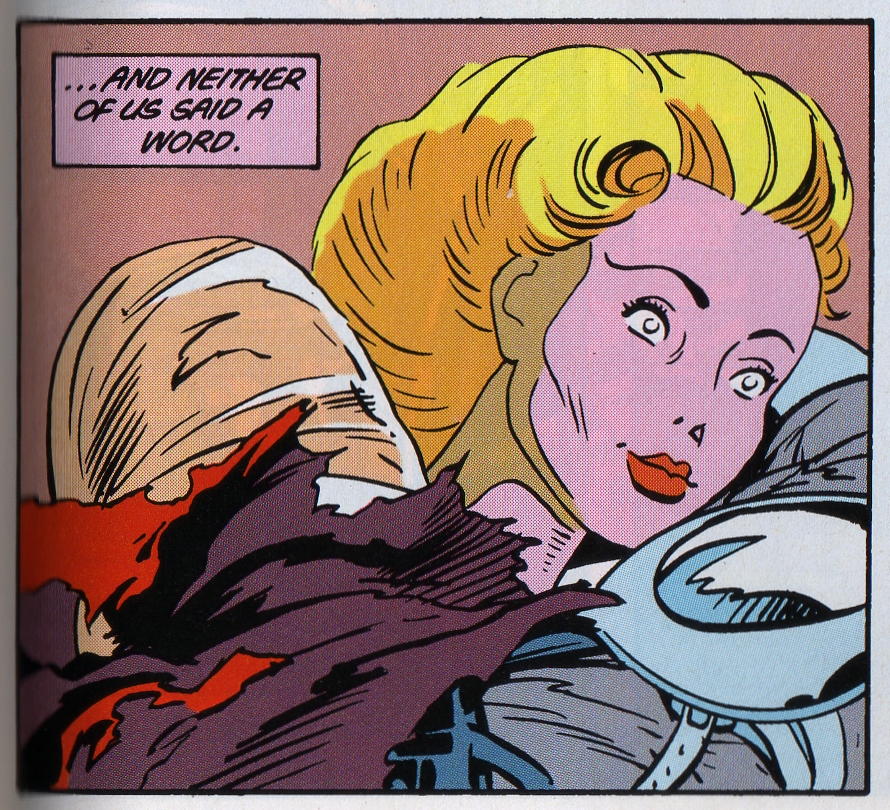
All you really need to know to get that he’s crazy is that Preston Payne is in love with a mannequin. Seeing it laid out as above, with “…and neither of us said a word” as counterpoint to the dead chilling face of “Helena,” is Moore mining the potential of comics for its full potential.
So much of what I love about Moore comes down to his exceptional ability to pull off moments just like that one. He is a supreme master of comics as a unique storytelling vehicle–part prose, part image, part something else entirely. Whether it’s a minor moment of Clayface hugging a mannequin or the virtuoso construction of Watchmen’s fifth issue, where Moore and Gibbons together build a “Fearful Symmetry” into the DNA of the page layouts themselves, Moore is so completely comfortable with the multiple levels on which sequential art can operate that his stories always redeem multiple readings. Even when he’s just telling a Batman story that’s not much about Batman for a random annual, meant to do little more than pile onto the limitless and ever-growing mountain of ongoing superhero fiction.
Batman himself doesn’t appear significantly until the final sequence of “Mortal Clay,” when he shows up to capture Clayface and is mistaken for the latest lover to steal the heart of “Helena.” Clayface and Batman fight, until Clayface collapses in a distressed heap before his mannequin, and Batman…offers his hand to the villain.
We then learn that while Clayface has been restored to Arkham Asylum, thanks to Batman’s intervention, he’s been allowed to live in relative happiness with “Helena.” It’s a side of the Caped Crusader we don’t see very often these days, but it’s welcome when it does appear; Batman has pity and mercy for many of his sickest adversaries.
These handful of stories don’t give us a great idea of Moore’s vision for Batman, except that Batman functions solely as a supporting or inciting character in each tale. That’s a decision by itself, and it suggests Batman as a figure of menace and mystery. Even as Moore wrote his Batman stories decades ago, the Caped Crusader’s interior life was becoming somewhat over examined. Placing Batman as a secondary character in his own story allows Moore to focus on Batman’s milieu and examine the character as reflected through others.
Of course, we could spend days dissecting the elements of Batman that inspired aspects of Rorschach from Watchmen…
That’s the thing with Batman: Even if you’re Alan Moore, Batman’s never really far away.
 Oonta Goota