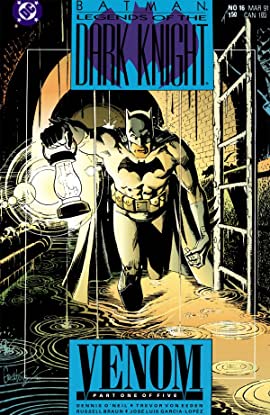
Just ten issues after his first storyline for Legends of the Dark Knight (“Shaman”), Denny O’Neil is back behind the word processor again for “Venom,” a five-parter with artists Trevor Von Eeden (layouts), Russell Braun (pencils) and the great Jose Luis Garcia Lopez (inks).
That’s a murderers’ row of talent, and it’s a shame that the work doesn’t live up to their reputations. “Venom” is known today more for what it introduced into the DC Universe than for the story itself–the “venom” in question is the same narcotic cocktail that will create Bane, and this story brings the drug to Santa Prisca, a fictional South American country invented by O’Neil during his run on the Question. We will eventually learn that Bane hails from Santa Prisca, where he was forced as a child to serve time in a maximum-security prison because his dad escaped–the kind of insane version of “justice” only a mid-nineties comic book writer could come up with.
“Venom” feels like a logline in search of a story, a character, a theme; anything to justify its existence beyond the simple high concept of “Batman gets hooked on performance-enhancing drugs.” It feels incredibly dated, its understanding of the illegal drug trade and its impact on the U.S. informed largely by the waning days of the first War on Drugs. Characters behave in ways that defy our previous understanding; Alfred functions solely as a long-suffering quip machine, his droll one-liners awkwardly punctuating even the most dramatic moments.
There’s something lumbering and gawky about the way it’s plotted, too; you have this big fat hook, “this is your Batman…on drugs,” and then he overcomes the addiction by the end of the third issue in the story, just so that he has time to play the Schwarzenegger role in a warmed-over redo of Commando. You can see O’Neil is trying to build sympathy around the son of one of the story’s two villains, but his father is such a grotesque pantomime of “old Army dude practices tough love on his family” that it defies belief.

Also beyond caricature is the “evil scientist” who creates “venom.” Batman’s inciting event in the story is the death of the scientist’s daughter in a drowning that Batman could have prevented if only he’d been physically stronger. When Batman appears to tell the scientist about the death of his daughter, the scientist barely reacts; within a few panels, Batman is taking the guy’s pills. It’s probably a bad idea to trust the pharmaceutical recommendations of a sociopath who can’t bother being upset about his young daughter’s death by drowning.
Tegan O’Neil does a much better job of dismantling this arc than I could. “Venom” has been around long enough that it feels like a necessary evil, a bedrock of the modern Batman mythos that exists solely because it has to. It gave us the Venom drug, which begat Bane, which begat Knightfall and countless other Bane stories and eventually The Dark Knight Rises. In spite of its dated, cloying story and unrealistic characterizations, we’re probably stuck with it.
 Oonta Goota