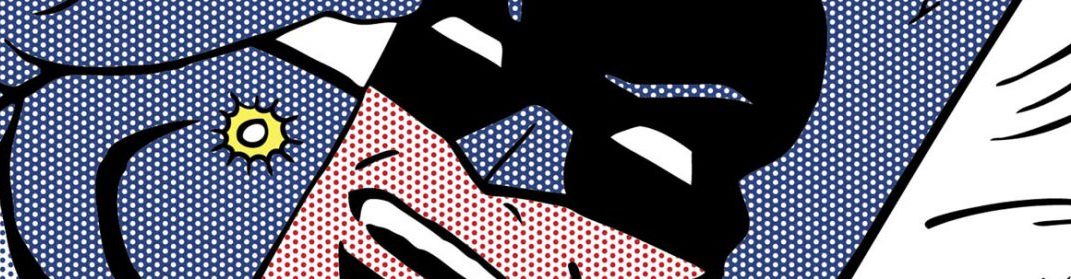
My first “prestige format” comic book was, naturally, The Dark Knight Returns. That was the first prestige release ever, and the format only increased in popularity throughout the late eighties and nineties, driven by the overall spike in the comics market and by intense interest in specific characters.
I have to imagine that prestige books were an easy way for publishers to clean up; maybe they cost a bit more to publish, but you still got to pay for maybe 48 pages of story (or less!) and mark it up to five or six bucks a pop.
This “golden age” of prestige one-shots was a fertile time for our favorite Caped Crusader as well, arriving during Batman’s first great run of megapopular movies. Again, the opportunity was too great for DC to pass up. In this occasional series, we’ll take a look at some of the many, MANY prestige format one-shots published during this era.

O, dystopia!
It provides the location for so much speculative fiction, as well as an easy out for writers who are too lazy to do anything more creative with their ideas. Even the most trite, unoriginal plots gain a little gristle when dropped into a hopeless future.
Which is not to say that Judge Dredd is a trite or unoriginal character. In fact, it’s probably fair to say that his emergence in the pages of 2000AD in 1977 helped establish the popularity of bleak dystopia in comics. From that fertile ground grew some of Alan Moore’s biggest hits of the 1980s and even the seminal Frank Miller joint The Dark Knight Returns. Perhaps it’s a jagged, dotted line between the two, but you can definitely see the connection.
All of that precedent makes the (inevitable?) meeting of Batman and Judge Dredd in Batman/Judge Dredd: Judgment on Gotham a bit of an anticlimax. With the success of the character’s dark and satirical stories, Judge Dredd helped begat the late 80s bleakness across the Batman line; the Bat-mania from 1989’s Tim Burton film demanded a glut of Bat-product to fill the Bat-shelves; by 1991 it was still going strong, inviting this one-shot by Alan Grant, John Wagner, and Simon Bisley. When Batman ends up in Mega-City One through some technobabble Macguffin, it’s like he’s visiting home.
So much of reading and writing about old comics is just examining these strange things as artifacts of their time and their cultural moment. This book would not exist if Batman comics weren’t in such huge demand in 1991, buoyed by the general rise in sales thanks to the dawn of the speculator boom. There’s also the sense in which the book’s tone is itself attempting to react against the push toward more graphic and “adult” storytelling in funnybooks. This was before the mature readers label existed, and so it’s jarring to flip through the book and see some of Judge Death’s incredibly gruesome murders, or the full page set in Judge Anderson’s apartment where she answers the phone in the middle of the night and climbs out of bed, wearing naught but a G-string and apparently oiled as though she were prepared to race off to an emergency weightlifter competition at any moment.
This is a very 90s comic in its way, but featuring a character who inspired much of the tone of 90s comics, written by guys who themselves invented a lot of the tricks in 90s comics back when they were really daring in the late seventies and early eighties. If their attempts at gross out humor or “butt” puns fall a bit flat, it’s hard to blame them; that material killed before everybody and their brother swiped it.
Storywise, it’s hard to fault Grant and Wagner, since their plot echoes the comfortable beats of just about every cross-universe superhero team-up. There’s a misunderstanding, a battle between the heroes, an unlikely alliance between signature villains, and then a climax in which both heroes save the day and say goodbye, but not before they realize that HEY, maybe they weren’t so different after all. They’re both workhorse legends in British comics, and Grant has the added benefit of approaching the book in the midst of his own time on both Detective Comics and Batman, along with artist Norm Breyfogle. They both “get” Dredd and Batman.

The star of this book, and the reason to give it at least a flip-through twenty-five years later, is Simon Bisley’s artwork. Bisley also came up through the ranks at 2000AD before making his way to the states and finding success as one of the signature artists on Lobo, a character who also owes much of who he is to the Dredd aesthetic and tone.
Bisley takes full advantage of this stand-alone prestige release to create a stand-alone visual universe that plays to his strengths, bright grotesque figures rising up out of a dark miasma. His character designs are outsized and impressionistic, with flashes of extravagant detail that push the look toward an almost abstract feeling at times. It’s virtuoso work, and even when the book’s plotting falls into comfortable storytelling grooves, the visuals carve into unexpected territory.
 Oonta Goota