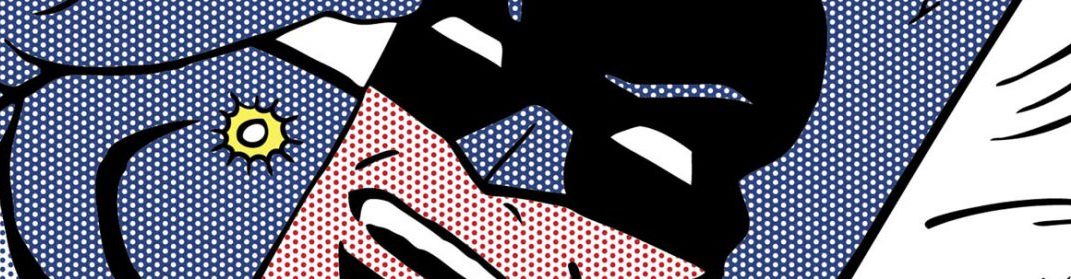

In college, I did a senior year thesis on Frank Miller, Klaus Janson & Lynn Varney’s The Dark Knight Returns, heavily inspired by Scott McCloud’s exceptional Understanding Comics. He explores a topic in that book that he calls “closure,” which is the reader’s effort to fill in the narrative or movement “blanks” between panels. It’s the imaginative leap that makes comics work. I wrote about a concept called “emphasis,” which is the creator’s choice of what to depict in any given panel–part illustration, part animation, part cinematography.
While the choice of emphasis by an artist seems obvious when a panel simply conveys story information, it’s just as often used to set mood and meaning. That was the crux of my thesis–a close read of the sequence in Dark Knight where Bruce Wayne recalls the death of his parents. We see closeups of Martha Wayne’s pearl necklace caught by the arm of her attacker; as the attacker pulls his arm away, the necklace is pulled apart. We see the necklace stretch and the pearls separate in excruciating detail. More than just suspense, this sequence builds an excruciating tension because of Miller’s emphasis in key panels on the pearls versus any number of other images he could have used to convey the same information.
Action sequences are another place where emphasis plays a huge role–the choice of what positions to depict for the participants can help convey a sense of motion, or if they appear too posed, give the sequence a halting, motionless feeling.
Klaus Janson’s work on “Gothic” has me thinking about emphasis again, because as a penciler, he chooses some weird poses to capture in his art.

In a sense, it’s similar to any number of familiar images of Batman–the dark knight falling from above with menace in his eyes, his arms outstretched, cape furling in the wind.
Except that’s not quite what we get here. There’s nothing that establishes Batman as being above the ground prior to this page, so it’s not clear of he’s dropping down from a height or maybe standing from a crouch. His arms aren’t outstretched, holding his inky black cape aloft; they’re in mid-motion, either extending the cape or bringing it in.
It’s a lived-in, real version of an image that’s existed before, and will exist countless times again. Janson’s own inks give the moment (and many others throughout the book) a kinetic charge, as close to a jump cut as you’ll see in comics.
But there is a firmness, a solidity in the image, and it’s in Batman’s face. That half-smile. It leaps out from the page. His full frame isn’t quite as menacing as his expression. And he dominates the rest of the page–not just because his reveal fills the top two-thirds but because he and his cape are in the foreground of almost every other panel.
It’s that preference for emphasizing unconventional moments and his disciplined control (or intentional lack thereof) of his line work that make Janson one of the all-time greats.
“Gothic” marked masturbatory shaman Grant Morrison’s first foray into Gotham City. In it, he shows a remarkable amount of restraint; his Batman is violent when necessary, thoughtful and careful otherwise. He can roust thugs on the streets one night and arrive in Vienna a few days later to visit a monastery in broad daylight.
Unlike some of Morrison’s other Batman projects, in “Gothic” he’s building a veneer of normalcy around a supernatural villain, Mr. Whisper. He uses the trappings of a grounded Gotham and a shoe-leather crimefighter to contrast against the eerie strangeness of his antagonist, a former monk from 300 years ago who embraced sin and made a deal with the devil to live for centuries in exchange for his soul.
Mr. Whisper has a whacked-out plan to use an architectural trick in Gotham Cathedral to unleash a new plague on the city. But he emerges in the story for very pedestrian reasons, at least in the Bat-verse–he’s tangled with Gotham mobsters in times past, and he returns to the city to gain some revenge.
Morrison overreaches a bit by casting Mr. Whisper not only as an immortal sadist and a serial killer, but also somehow one of Bruce Wayne’s teachers at boarding school. But he does pick up a set of plotting threads that play off the Year One theme of Legends’ early storylines, one that we’ll see later writers pick up as well–mirroring Frank Miller’s original tale, Morrison parallels storylines set in Gotham’s criminal underworld, in the city’s police ranks, and in the adventures of Batman himself. At times, it’s clever to watch creators play with those threads and weave them together; in other storylines, as we’ll see, it’s a burden more than an aid. Morrison makes the most of it, and it gives him license to ease into Mr. Whisper’s supernatural origins after introducing him as a seemingly run-of-the-mill mob killer.
Next: Moench/Gulacy/Austin on Prey
**A brief postscript–a far better critic than I has already tackled this story, and that’s comics blogger and all-around exceptional writer Tegan O’Neil. In fact, she toyed with doing her own story-by-story write-up of Legends of the Dark Knight in 2015. I’ll be linking to the pieces she completed as I finish my own write-ups, so by all means, visit her take to get a more Morrison-centric look at “Gothic.” And here’s her piece on the previous storyline, “Shaman.”
 Oonta Goota