Monthly Archives: June 2021

My Favorite Batman

We started our exploration here of all things Batmanish with a simple statement of purpose: There is no “definitive” Batman. It follows, then, that all Batmen are worth our time, whether wacky or gritty or remarkably sane. 

That doesn’t mean I don’t have a favorite Batman, or several; for the longest time, one stood pretty clearly in the lead, and that’s Frank Miller’s Batman, as depicted in The Dark Knight Returns. Easy answer, but I gotta keep it real. 

That’s from a character perspective. Based on visuals alone? Jim Aparo, followed closely by Norm Breyfogle. 

After I finally got off my duff and read the legendary Steve Englehart/Marshall Rogers run of Batman, it dawned on me that maybe the EngleRogers (does that work, like a “Brangelina” kinda thing? Maybe yes?) version of the Caped Crusader is now my favorite. 

Because frankly, Batman’s been depressing as hell for a really long time, and EngleRogers’ Batman is actually (gasp) FUN.

***

We all know why Batman is. One minute, he’s an eight-year-old skipping out of a screening of The Mark of Zorro; the next, he’s kneeling in a pool of his parents’ blood, which usually also contains bits of pearl necklace and movie theater popcorn. 

It’s an incredibly simple, elegant origin. It’s lasted for the better part of seventy years with nary a tweak. It doesn’t just work; it RESONATES. You may or may not be the vengeful type, but you can at least understand the cataclysmic event and its emotional fallout. You yourself may not choose to become a Creature of the Night in response to your own parents’ murders, but you can sorta see where Bruce is coming from. 

The problem with that origin is that sometime round about the emergence of Mr. Miller’s vision of the character, the origin stopped being an inciting moment and became far more. Because it’s an easily-drawn line connecting lil’ Brucie in that alley and Big Bruce dressing up in a bat costume, that line has become everything the character is. The death of his parents grew to be far more than just Batman’s origin; it became the totality of his being.

Which is what led us to Bat-Dick, the popular online term for the asshole Batman who prowled the streets of Gotham for decades, since the immense commercial and critical success of Miller’s Year One and Dark Knight Returns

There’s something about those two stories standing as they do at the dawn and the twilight of Batman’s career that underscores the origin-as-essence phenomenon; later creators must have looked at these two towering tales and realized, subconsciously or otherwise, that Miller had already done the heavy lifting for them. Whatever happened to Batman in their stories, it was simple enough to plug it into the template, since the template was not just easy and well-defined, but literally spanned Batman’s entire life as a character, as defined by Miller. 

So: Miller draws the pearls and the popcorn; a parade of talented creators fall in line; we get thousands of pages of angry, vengeful Batman, some of which is good stuff, but all of which is frankly a fucking downer.

(Of course, as I do a bit of internet research for my next trick, I discover a far more talented writer has already done an incredible piece on EngleRogers’ Batman. Apologies in advance to Peter Sanderson if I eventually follow along the path he carefully cleared through the jungle of Batman, and we’ll get back to his essay in a moment.)

What struck me most about the EngleRogers Detective Comics run is that their Batman is not a character defined by vengeance. The death of his parents is what drove him to become Batman, but it is not what drives him to continue being Batman. 

What keeps him going is a sense of justice, and frankly, a sense of adventure–you get the sense that the EngleRogers Batman enjoys what he does, and that he’s not undertaking some solemn, lonely vocation that would handily destroy most men, and quickly. 

If you stop for a second to think, it almost seems essential that Bruce Wayne actually likes being Batman. Far be it from me to require “realism” in my funny books, but it is far easier to understand a Batman who is incited by vengeance and driven by justice, than it is to imagine a character for whom vengeance is the only motivation.

Human beings aren’t built for single-minded pursuits, and those who pursue them tend to be quickly destroyed by their own obsessions. A Batman who does what he does solely to exorcise an endlessly-replenished well of rage is a Batman who is probably gonna let his feelings get the better of him, and get sloppy as a result.  Again, in comics “anything is possible,” but the Batman-as-rage-monster characterization makes the character harder to empathize with, and harder to support.

There’s lots more to love about EngleRogers’ Batman; his relationships with Dick Grayson, Silver St. Cloud, and Alfred all seem much more healthy and grounded, and the guy’s actually able to deal with police and citizens without terrifying everyone who bumps into him. But it all stems from the central conceit of Batman as dark, heroic adventurer, NOT Batman as brooding, vengeful sociopath. 

In interviews just prior to launching his run on Batman, writer Grant Morrison referenced the “Neal Adams hairy-chested love god” version of the character, and that quote certainly stuck in my mind. On reflection, I think Morrison actually aimed for more of an EngleRogers conception of Bruce Wayne, one able to absorb all of the various aspects of the character without becoming too beholden to any of them. Bruce Wayne had an actual healthy romance again (at least, until she went and got evil on him), he had more fully developed relationships with his supporting cast, and he dealt with a wider range of threats than the vicious street scum he would regularly beat to within an inch of their lives as the Deep, Dark Knight.

Then there’s the issue of Morrison’s run as all-encompassing clearinghouse for ALL of Batman’s history–he’s said that he’s taking the approach that every adventure we’ve seen Batman have since 1939 actually happened to this guy over the span of twelve-odd years. That again has echoes of EngleRogers, as Sanderson astutely points out in his essay linked above:

All of this reflects a different mindset than that which prevails in comics today. Englehart believed in drawing from and incorporating the classic stories of the past, presumably not just because they provided him such rich material, but also out of respect for the writers, artists and editors who created those stories. Englehart was presenting his stories as the latest in a long and honorable tradition. How different this is from the current fashion in comics, whereby classic stories are regarded as dated antiques to be superseded by new versions by whoever the current hotshots are considered to be.

Englehart’s approach was more of a pick and choose strategy, closer to what Geoff Johns has done with heroes like Green Lantern and now Superman; Morrison’s actually dragging it ALL in to see what that does to Bruce Wayne. But the principle’s similar.

Morrison took Batman on quite a freaky psychological journey, and I enjoyed his Batman more than any I’ve read in years. It’s because Morrison’s conception of the Dark Knight owes quite a bit to the EngleRogers version of the character. It’s a Batman you WANT to read about, that you want to cheer for, and that you want to see happy. 

That’s right–a balanced, HAPPY Batman. Shocking, but as Englehart and Rogers demonstrated, quite possible, and quite entertaining.

Batman: Reptilian #1

What we’re talking about here is a billionaire aristocrat who beats up poor people, as well as the mentally ill. I don’t know what that has to do with a code of honor, but it certainly appeals to my sense of humour…”

I love Batman as much as at least one of my three kids (which one changes daily), but it’s also important to keep an open mind about the character. As I’ve said since the start, there is no such thing as a “definitive” Batman. 

So reading that quote from Garth Ennis, writer of Batman: Reptilian, got me more than a little excited. Ennis’ superhero-adjacent books (Hitman, The Boys) have specialized in lampooning the entire concept of caped crusaders, run through with a biting edge of satirical commentary and the occasional lapse into genuine affection for the characters. For Ennis, the mere idea of superheroes is insane; most of the people who do it are also insane; and any sensible person who wants to save the world has the good sense not to tart up in a crazy costume to do it (to paint with a broad brush!). 

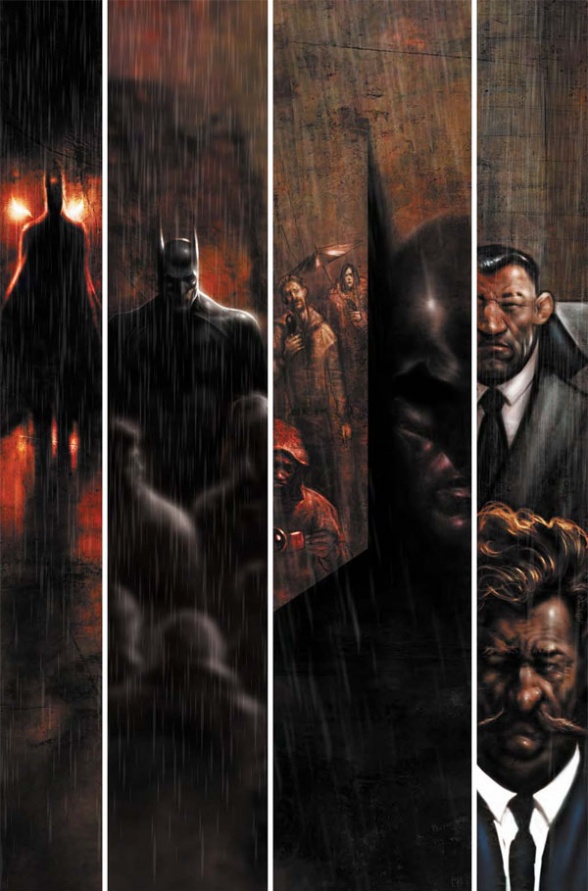
With Batman: Reptilian #1, Ennis is definitely laying the groundwork for a fully satirical take on Batman, one that feeds off the most extreme expressions of his modern depiction in comics, but keeps him just grounded enough for the story to carry a hint of danger. It stops just short of being an outright lampoon, although Liam Sharp’s artwork creates an exaggerated atmosphere; Ennis and Sharp both seem to want the violence to land, to be just “real” enough to matter, in order to make Batman’s reflection in the funhouse mirror all the more biting. 

Someone is attacking Batman’s rogues in Reptilian, in grotesque acts of violence that Batman doesn’t seem to realize are a logical extension of the violence he himself has brought upon the criminal world. A short prologue depicts Batman crippling an acquitted but guilty rapist on the steps of the courthouse in broad daylight, a moment that sets the tone for Batman’s character in the book–deluded enough to think his borderline psychotic attacks are always commensurate with the crime he is trying to prevent.

That undercurrent has been in the Batman books for a few decades at least, but Ennis is pulling it out from beneath the character’s inciting trauma and examining it in dim, cold daylight.

Ennis meant for this script to be drawn by Steve Dillon, his co-conspirator on Preacher, Hellblazer and The Punisher, before the artist’s untimely death in 2016. It’s bittersweet to imagine the pages done by Dillon, but this also feels so completely within Sharp’s wheelhouse that it takes on its own full identity. It reminded me of Dave McKean on the Arkham Asylum graphic novel; impressionistic but tactile, splotches of color and light pulling focus from within a turgid morass. 

That’s somewhat appropriate, because as Ennis himself reveals, “Perhaps the best way for regular Batman readers to think of the book is this: Imagine that the last thirty or so years’ worth of Batman comics never existed. Because as far as I can recall, that’s how long it’s been since I actually read a Batman comic from start to finish…Just think Dark Knight, Year One, Killing Joke and not an awful lot more. Think the late ‘80s to the early ‘90s. That’s really when Liam and I hail from.”

With Reptilian, Ennis is taking that incarnation of Batman and deflating his outsized Dark Knight status, using his own tone and universe as weapons against him. Considering how twisted and poisonous that take on Batman became almost immediately upon release, it’s a thrashing long overdue. 

Stop the Press! Who’s THAT?!

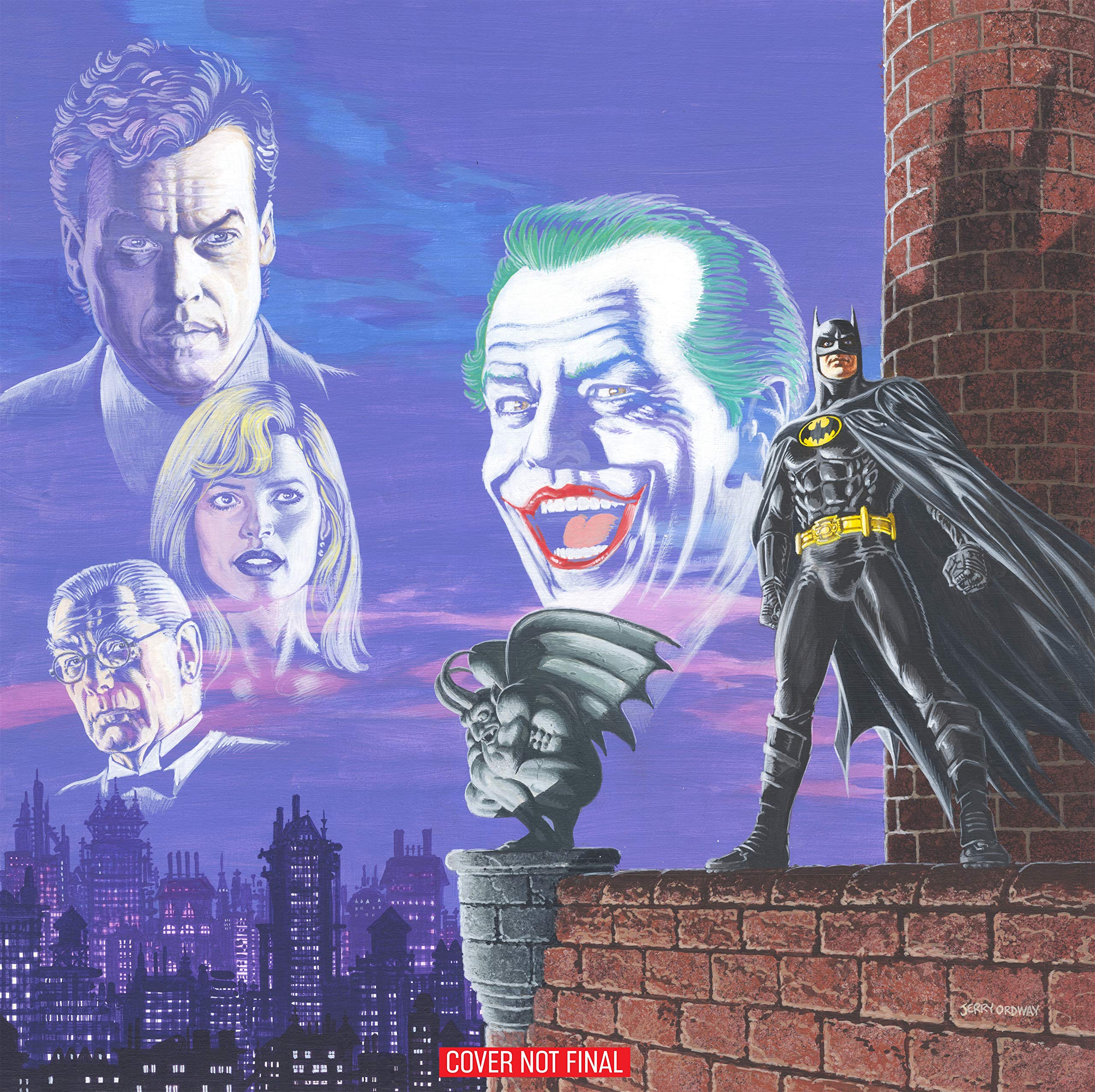
Jerry Ordway’s brilliant cover for the Batman movie adaptation

Picture a Pre-Pubescent Mattie (PPM), acne sprouting up like weeds across the oily plain of his face, visiting his local comic book shop.

PPM’s eyes dart across the racks. His heart starts to race. His hand adjusts the Bat-signal trucker cap perched awkwardly atop his enormous head, back when those were worn only by actual truckers and the hopelessly unfashionable.

PPM picks up every Batman comic he can find; later that day he devours them voraciously, laying on his bed beneath his Batsignal poster, his Bartman poster, and the poster he took from an old comic book magazine of Adam West and Burt Ward in their Dynamic Duo garb from the sixties.

Yes, little Pre-Pubescent Mattie had Bat-fever.

I was OBSESSED with Batman in 1989. Totally out of my head. I still remember the exact date that Batman premiered in theaters: June 23, 1989. I remember it because throughout the last half of my seventh grade year, I lived for that date.

I. Absolutely. Could. Not. Wait. For. This. Movie.

And so the Tuesday after the film came out, my dad took an afternoon off from work and we went to see Batman at the once-beautiful River Oaks Theaters in Calumet City, IL.

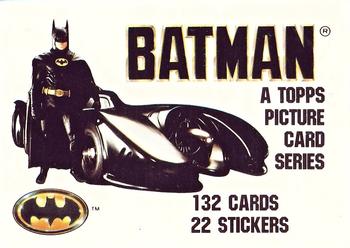
My Trapper Keeper the next school year was covered in stickers from the “Batman” trading cards. My sister and I obsessively collected each and every one of the cards to form a complete set. In art class, I devised ways to incorporate the classic oval Bat-symbol into my projects. I took to decorating my Batsignal trucker hat with buttons from the comic book and sci-fi conventions I started to attend in high school. (My favorite? The “Kirk/Spock in ’92” button.)

Batman was not the first pop culture phenomenon to knock me over the head and take me captive. But it was the first time I fully chose of my own volition to embrace a big pop moment, to stand alongside the seething masses in our Bat-signal T-shirts jamming to “Batdance” on our Walkmen headphones. It was everywhere, and so was I, slurping it all up without hesitation and loving every second of it.

As a movie, it’s a simple story, and that’s one of the big reasons it works. Director Tim Burton and screenwriters Sam Hamm and Warren Skaaren don’t clutter their film with extraneous villains who are more a lampoon than a serious threat; there’s no Ahnold muttering idiotic quips with his face painted blue, or Danny DeVito limping around with fins over his arms. (Though I do think Batman Returns is largely underrated…) It’s lean storytelling that focuses on what’s important, which is the duality of Bruce Wayne and the viciousness of the Joker.

The story isn’t what makes it so damn watchable; it’s more about a mood, a feeling, atmosphere. It’s a triumph of style over substance, which is something that can be said about many of Tim Burton’s films…and frankly, about many Batman stories over the years. The movie teeters at the edge of being aware of its own heightened artifice, tiptoeing just to the edge of showing off the wires that help Batman swing and the grotesque facial appliances that give the Joker his rictus grin.

Burton’s Gotham is a city on its last legs where only evil exists in primary colors. His Joker is a horrifying lampoon of a circus clown who gets off on combining pure naked bloodlust with his playful exterior. And his Batman is an unrelenting force of justice, consumed by revenge against an enemy he can never defeat. Production designer Anton Furst creates a twisted nightmare version of New York where every corner seems to end in a dark alley and criminals rule the streets.

There’s a distance to it all, a theatricality that seems rooted in the halting rhythms of comics, not as they were in 1989 but as they were at their birth in the 1930s. Images stand out beyond story…Michael Keaton stretching his batwings out over a couple of thugs, the Batmobile snaking its way down a leaf-covered forest road…they linger in the mind like or the iconic cover of Detective Comics 27, Bat-Man swinging down onto hapless criminals, justice raining down from on high.

This staged feeling, almost as though the characters themselves are performing and not just the actors, fits with the whole identity-as-mask theme that’s central to the film, and that’s always been a core part of Batman’s appeal. As his character has developed, so also has a simple question with no easy answer: Is Batman Bruce Wayne, or is Bruce Wayne Batman? Which is the reality, and which is the disguise? Burton dives more directly into these issues with his second Batman film but it’s there in the first film too, in the overall unreality Burton and his crew create–the heightened, yet darkened, sense of drama and action.

Looking back, there was something formative in my embrace of Batman. In the duality of Bruce Wayne and his alter-ego, I found a reflection of my own emerging personality complex—a rift torn inside myself, one side presenting a relatively happy and uncomplicated side to the world, and the other side suffering under crippling self-hatred. (Okay, so maybe that’s more Harvey Dent and Two-Face than Bruce Wayne and Batman, but work with me.)

In this story, just as in others I would soon discover, I found a sweeping and romantic expression of a character divided against himself, in an outright conflict with the world around him that only he really understood.

I was a Bat-fan before Tim Burton’s film…but in a way, my whole lifelong desperate romance with the minutiae and ephemera of pop culture started with the 1989 incarnation of Bat-mania, and the film that inspired it. Although it may not have cracked open my insides, it gave my self-loathing a mirror in which to peer.

Bats and Legends: “Shaman”

Four covers…advantageous!

As any Bat-fan worth their salt already knows, 1989 was a seismic year in the history of Batman, due primarily to the release of Tim Burton’s film in June. 

With that movie’s explosive popularity came any number of attempts to cash in, from T-shirts and toys to trading cards and (I would assume) toilet paper. As the publisher of Batman comic books for fifty years, DC Comics was uniquely positioned to reap the benefits of a hit Batman movie. 

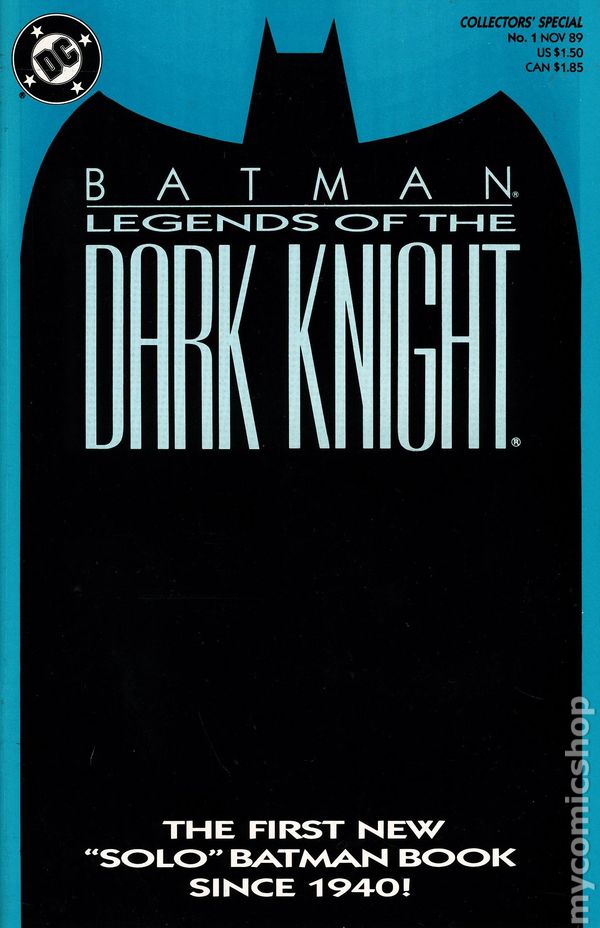
And so it came to pass that in November, they launched Legends of the Dark Knight, which they billed as “the first new solo Batman title since 1940!” This was a ham-handed attempt at infusing the launch with more gravitas than it deserved; it may have been technically true, but everyone knew that there had been countless Batman series launched and relaunched in the decades since Batman #1 hit the stands. 

Still, it was the late eighties, the start of a heady period in comics publishing, when anything that could be An Event became An Event. So Legends #1 was a Big Deal with four separate covers…actually, four separate cover wraps, which is absolutely cheating. The cover itself was the same, but a separate piece in four garish neon pastels was attached to the book, forcing completists and speculators alike to track down all four colors for their collections and/or future college funds. 

This series lasted until 2007. It spanned four additional Batman movies, four animated series, and some OnStar commercials. It told the kind of stories that the “real” Batman books could never tell–stand-alone tales, often just loosely in continuity, and many times focusing on the early years in Batman’s career. 

I read and collected many of the issues of Legends as it was published. I’m going to try to read and write about every storyline in the series, as an exploration of the character and his world, and an examination of how a wide range of different writers and artists approached the character. I will probably give up at some point out of sheer exhaustion–there are probably upwards of 100 different stories told over the 215 issues of the original series, plus 10 annuals and specials–but we’ll see how it goes. 

“Shaman” is the storyline that kicks off Legends, stretching across issues 1-5. The issues are written by Dennis O’Neil, aka Denny, who also edited the entire line of Batman comics for DC from 1986 to 2000; art duties are covered by penciler Ed Hannigan and inker George Pratt. 

O’Neil is a towering figure in the history of Batman; as an editor, by 1989 he’d already had a hand in the two foundational stories of modern Batman, both by Frank Miller–Year One and The Dark Knight Returns. Those two stories were themselves influenced by O’Neil’s foundational work as a writer with artist Neal Adams on Batman in the 1970’s, widely credited with returning the Bat to a more grounded, gritty tone after the camp explosion of the sixties. 

Year One and Dark Knight Returns effectively bookend Batman’s fictional career–Batman’s origin in the death of Bruce Wayne’s parents has been clear enough since the 1940s, but Miller used these two stories to expose the psychological underpinnings of that seminal event. It didn’t change Bruce Wayne as much as it transformed him, destroyed him; if there was ever a question before, it was clear from 1986 on that Bruce Wayne was the mask, and Batman was the reality. 

In “Shaman,” O’Neil picks up on that dichotomy and explores it as it began, weaving in key moments from Year One and squarely placing this particular murder investigation between the panels of that previous work. O’Neil’s intellectual curiosity bleeds through in much of his work, and here it’s an effort to connect bits of Native American mythology to the Batman mythos. Honestly, it’s a little unclear whether the central parable O’Neil relates is an invention or drawn from his research, but either way, it’s an overt tie to the more mystical aspects of Native American history. 

There’s definitely something of the Magical Native American trope at play in this story; at the same time, Hannigan’s pencils give these characters a lived-in reality, and he uses a clever stylistic shift to illustrate the actual bat-related parable that lies at the center of the tale. Hannigan also instinctively understands that one of the keys to a great comics fight scene is effectively depicting motion.

“Shaman” is not a great Batman story; it suffers from a frequent weakness of stories with long-running characters, where the author feels the need to relate what’s happening to some other landmark event in the character’s history. Here O’Neil stretches a bit too far to suggest that the famous bat crashing through Bruce Wayne’s window was somehow related to the mystical healing efforts of a Native American in Alaska. 

But in “Shaman,” Batman is pretty great. O’Neil nails the tense, passive-aggressive banter between Batman and Alfred, and isn’t shy about throwing in some well-choreographed fight scenes. Hannigan’s Batman is all business, lean and powerful, and there are a few classic Batman breathtakers in here that showcase the Dark Knight in all his nocturnal glory. 

I think what I like most about O’Neil’s writing is that he’s so well versed in the simple rhythm and style of crime fiction. He writes a great Batman but he also crafts great thugs and cops. His work on the character, especially in the post-Year One era, feels like Batman wandering into a James Cain novel. It instantly grounds the action and provides a helpful context for the activities of a nutty genius running around in a bat costume. 

Next: Grant Morrison’s first take on Batman

Six Pages

How many Batman stories are there, anyway? I’d be tempted to count, if I could quit my job and get paid handsomely by some eccentric billionaire to do nothing but count Batman stories.

There’s at least 690 stories in Batman’s eponymous title alone. Of course, some issues had more than one story; others are part of a larger story arc. Detective Comics adds another 858 to the pile. Batman Family, Legends of the Dark Knight, Shadow of the Bat, an endless array of miniseries, one-shots, Elseworlds, guest appearances…like I said, full-time job. And that’s just in comics; there’s several TV series and movies to consider as well, plus video games, prose adventures, and so on and so on and so on…

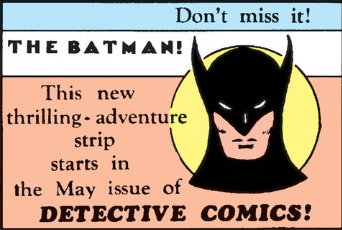
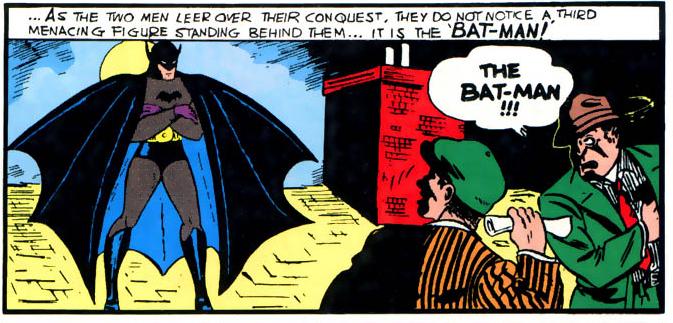
Considering the almost unimagainable volume of Batman stories over the past seventy years, it’s pretty astonishing to consider it all began with just six pages. Detective Comics #27, cover-dated May 1939, boasted a Batman cover, but only a single six-page interior story devoted to the Caped Crusader. The rest of its 64 pages were filled out by an odd assortment of gag strips, action strips, prose pulp adventures, and some actual detecting here and there too.

So, six pages. Six pages with which to introduce a character who would continue to be published non-stop for the next seventy years. Six pages to spawn a pop culture phenomenon–movies, music videos featuring androgynous pop stars, pillowcases. Six pages that are a landmark in our cultural history.

They’re six good pages, scripted by Bill Finger and drawn by Bob Kane, today together regarded by most as the creators of Batman. It was Finger who became Kane’s initial and most influential co-conspirator in building up what we know today as the Batman “mythos,” though I’m sure some hate that word. (At least I didn’t call it “canon.”) “Young socialite” Bruce Wayne and Commissioner Gordon both premiere in this first story, along with the Bat-Man (dash included); it would take several more issues for other bits of Bat-iconography to appear, such as the Batarang and bat-themed methods of motorized conveyance. (In this original adventure, Batman drives a nondescript red car, like he’s just borrowing wheels from a particularly boring friend until his pimped-out superhero ride is ready.)

This first story, “The Case of the Chemical Syndicate,” reads to today’s eyes like warmed-over second-hand crime fiction, something one of the minor Law & Order shows might whip up for a non-sweeps episode. There’s four guys and someone dies, and they’re in some chemical business together, and one of them wants the whole money for themselves. Or something.

Who cares, really, when the top of the first page gives us our first look at this Bat-Man, framed in silhouette, promising mystery and intrigue and darkness? The rest is a dull moan, except when this Bat-Man shows up again, and punctuates the proceedings with the physical violence that even in comics’ dawning days was already the visceral payoff to whatever convoluted story had to be serviced to get the reader to the good stuff.

As a casual fan at best of golden age comics, a few things surprised me. First, the silence. As in, there is some. I always imagine golden age stories as heavy with text, whether it’s dialogue balloons or looming captions that compress the images in each panel down into tiny tableaus. Even in this initial story, Kane and Finger are already experimenting with moments of pure action, minus any text whatsoever; over the first year of Batman in Detective, they’d push this envelope even further to create moments of surprising and quiet mood.

It’s also jarring just how unconnected the sequential art is in this story as compared to any modern comics. It may be the influence that film storytelling has slowly gained over comics storytelling that compels creators today to develop more cohesive scenes that spread out over pages, instead of moving a story forward at a more compressed pace; creators today also have far more space to spread out than these six pages, so they decompress, leading to 22 page issues that read more like a chapter in a book than a filling installment of story. In “Syndicate,” the panels are less frames from a film than snapshots of a series of scenes, with stray moments of true “sequence,” where you can somewhat follow action from one panel to the next.

You probably already know that at this point in his career, Bat-Man had no trouble with criminals meeting their “fitting end” in the course of his pursuit. He’d change that tune quickly, and he’d meet Dick Grayson, and he’d start looking out for the Bat-signal and settle pretty quickly into a Batman (no dash this time) we recognize as the same one we read about today.

In these first SIX PAGES (sorry, I just can’t get over it, so so much from so so little), the Bat-Man is still rough around his edges, and raw. Yet even here, the darkness draws in, and this “mysterious and adventurous figure” already begins to fascinate.